Important Update: Temporary Closure of the Nancy S. Klath Center Due to water damage, the Nancy S. Klath Center (101 Poor Farm Road) is temporarily closed for construction. For your safety, please do not visit the building. We will share updates as soon as it is ready to reopen.

Banks Are Becoming Bulwarks Against Scams for Vulnerable Seniors

The first call came just before Thanksgiving last year. She didn’t recognize the phone number, but she answered anyway.

“The person said he was an officer of the Department of Criminal Investigations looking into drug trafficking and money laundering,” the woman recalled. He seemed to know a lot about her: the states where she and her late husband had lived; his name and occupation; and her current address in Washington County, Rhode Island.

On her phone, he showed her a convincing badge and a photo ID with his name (“‘Frank’ something”), plus an article describing the supposed investigation. The woman, a 76-year-old retiree, denied any involvement.

“You can hire a very expensive criminal defense attorney, or you can cooperate with me,” Frank told her.

“Now, when you think about it, it doesn’t make any sense,” the woman acknowledged recently. But persuaded by the badge and ID, she agreed to cooperate. Otherwise, “I thought they were going to come and arrest me.”

Frank called each morning to learn where she was going, what she was doing. His team would be watching, he warned. The woman, feeling “petrified,” started looking around as she drove to garden club meetings. Was somebody following her?

It was all a scam.

Because victims’ sense of shame often leaves them reluctant to report such crimes, the extent of elder financial exploitation is hard to calculate. The Federal Trade Commission reported losses of $2.4 billion in 2024, largely driven by investment and romance scams and impersonations, with total losses much higher.

Americans age 60 and older lose more than $28 billion annually to financial exploitation, AARP estimated in 2023.

As those numbers rise, because the population is aging and predators are growing increasingly resourceful, banks and investment firms are becoming the first line of defense.

Frank’s initial target: her account at Fidelity Investments. He instructed her to shift about $250,000 into her checking account, telling the financial adviser at her local office that she and her family intended to buy real estate.

That scheme fizzled when the adviser said Fidelity could not approve the transaction without more information on the property.

So Frank sent her to her local branch of Washington Trust Company to take $70,000 in cash from a home-equity line of credit. “We don’t give out that much in cash,” the teller said, quietly messaging the branch manager, who had known the woman and her husband for years.

The manager ushered the woman into her office to talk, and the scam stopped there, with a call to the local police. The woman’s assets remained intact, but the experience proved so mortifying that she has not told even her family how close she came to losing much of her life savings. The New York Times is withholding her name to spare her embarrassment.

“I felt so stupid,” she said. “I felt like a fool.”

Financial predators targeting older adults represent “a heightened focus for us now,” said Mary Noons, president and chief operating officer of Washington Trust.

A regional community bank, Washington Trust cranked up its efforts last fall to advise older customers and their families about finances, including the dangers of elder fraud and exploitation. It published and distributed a booklet called “Age With Wisdom” and brought in an expert on dementia to speak with staff members.

And it became one of the 1,500 financial institutions to date to use BankSafe, a free AARP video program that trains front-line employees to spot the red flags indicating possible elder exploitation and to intervene. Everyone at the branch where the 76-year-old banked had taken the training.

“Some older customers visit their bank far more frequently than they see their health care providers,” Noons pointed out.

Until recent years, financial institutions placed “more of an emphasis on the autonomy of the client,” said Pamela Teaster, director of the Virginia Tech Center for Gerontology and an elder abuse researcher. Their approach was, “an adult has the capacity to make poor choices, and we’re going to let them make them,” she added.

But changes in government and industry policies and practices have encouraged greater vigilance. Congress passed the Senior Safe Act in 2018, protecting banks and financial firms from liability if they reported suspected exploitation to authorities.

That year, the Financial Industry Regulatory Authority began requiring member firms to ask for a trusted contact person when investors open or update accounts. (The account holder isn’t obliged to provide one, however.) And since 2022, it has allowed firms to place holds on older investors’ transactions if they suspect exploitation is involved.

About half of states have enacted laws that permit financial institutions to deny suspicious transactions or impose holds for specified periods to allow investigations, said Jilenne Gunther, the director of BankSafe.

“It adds friction,” she explained. “With space and time, the criminal gets worried and might move on. And the potential mark has time to stop and think.”

Teaster’s analysis of data from BankSafe, during a six-month pilot in 82 financial institutions, found that participants were much more likely to report suspected cases and save customers money than a control group was.

Not all of older adults’ losses result from predators, however. They can, on their own, get caught up in investment fads, take on too much debt, or make otherwise unwise decisions, even without criminals pulling the strings or relatives looting their accounts.

Managing finances presents complex cognitive challenges, said Mark Lachs, co-chief of geriatrics and palliative medicine at Weill Cornell Medicine. “It requires a lot of brain,” he said, including: “Memory, remembering that a bill is due. Executive function, the ability to manage your time. Abstraction, hypothesizing about your future.”

He added, “Financial errors are not infrequently the first sign of impending dementia or a neurocognitive disorder.”

2024 study by the Federal Reserve Bank of New York, for instance, found an increased probability of delinquent payments and deteriorating credit ratings in the five years before a dementia diagnosis. Those errors can reduce seniors’ access to credit and raise their interest rates on loans at the very point when caregiving expenses are likely to soar.

Lachs has called on fellow doctors to recognize what he calls Age-Associated Financial Vulnerability, a syndrome that can affect even older people with normal cognition, especially if they contend with medical illnesses, sensory deficits, or social isolation.

And he remains skeptical about the financial industry’s claims of heightened attention to its oldest customers. “I still see concerning financial transactions executed that should have received far greater scrutiny,” he said.

Training more front-line staff members and increasing emphasis on establishing trusted contacts for older customers would help, Gunther said, because “once the money leaves the account, it’s near impossible to ever retrieve it.” More states could enact laws allowing financial institutions to deny suspicious transactions or impose holds.

Several related bills with bipartisan support are working their way through Congress. The National Strategy for Combating Scams Act would require the FBI to coordinate efforts to protect seniors. A bill that restores an IRS deduction would at least provide the consolation of excusing scam victims from paying taxes on money they no longer have.

However, new weapons like artificial-intelligence voice cloning — in which the supposed grandson four states away who urgently needs $5,000 in gift cards actually sounds like the victim’s grandson — keep advocates and bankers awake at night.

In the Washington Trust branch where the Rhode Island woman didn’t lose her money, employees just days earlier had stopped a scam similar to the one that had targeted her.

But more recently, nobody spotted any danger signs when an older woman withdrew $9,000 for a kitchen renovation, until it went to a scammer instead of a contractor.

The New Old Age is produced through a partnership with The New York Times.

Wheelchair? Hearing Aids? Yes. ‘Disabled’? No Way

That’s a shame because accommodations of all kinds are available for those willing to ask for them. Many are required by law. Journalist Paula Span reports on the situation in this column, posted on KFF Health News on December 11, 2025. It also ran in the New York Times. Funding from the Silver Century Foundation helps KFF Health News produce articles (like this one) on longevity and related health and social issues. 

In her house in Ypsilanti, MI, Barbara Meade said, “there are walkers and wheelchairs and oxygen and cannulas all over the place.”

Barbara, 82, has chronic obstructive pulmonary disease, so a portable oxygen tank accompanies her everywhere. Spinal stenosis limits her mobility, necessitating the walkers and wheelchairs and considerable help from her husband, Dennis, who serves as her primary caregiver.

“I know I need hearing aids,” Barbara added. “My hearing is horrible.” She acquired a pair a few years ago but rarely uses them.

Dennis Meade, 86, is more mobile, despite arthritis pain in one knee, but contends with his own hearing problems. Similarly dissatisfied with the hearing aids he once bought, he said, “I just got to the point where I say, ‘Talk louder.’”

But if you ask either of them a question included on a recent University of Michigan survey—“Do you identify as having a disability?”—the Meades answer promptly: No, they don’t.

Disability “means you can’t do things,” Dennis said. “As long as you can work with it and it’s not affecting your life that much, you don’t consider yourself disabled.”

Their daughter Michelle Meade, a rehabilitation psychologist and the director of the Center for Disability Health and Wellness at the university, accompanies her parents to medical appointments and tends to roll her eyes at their reluctance to acknowledge needing support.

Working with other researchers on the recent national poll has shown her how often older adults feel that they are not disabled despite ample evidence to the contrary.

Many people still feel like ‘disability’ is a dirty word.

— Megan Morris, PhD

The survey looked at nearly 3,000 Americans aged 50 and older and found that only a minority—fewer than 18 percent of participants over 65—saw themselves as having a disability.

Yet their responses to the six questions that the Census Bureau’s American Community Survey uses to track disability rates told a different story.

The survey asks whether respondents have difficulty seeing or hearing, limitations in walking or climbing stairs, difficulty concentrating or remembering, trouble dressing or bathing, difficulty working or problems leaving the home.

In the university’s survey, about a third of those aged 65 to 74 reported difficulty with one or more of those functions. Among those over 75, the figure was more than 44 percent.

Moreover, when respondents were asked about several additional health conditions that would require accommodations under the Americans with Disabilities Act, including respiratory problems or speech disorders, the proportion climbed even higher. Half the 65-to-74 group reported disabilities, as did about two-thirds of those over 75.

Yet only a sliver—fewer than one in five—of older adults had ever received an accommodation from their health care providers to which they are legally entitled under the ADA.

Even among the small minority who identified as disabled, only a quarter had asked for an accommodation (though a third received one, whether they asked or not).

“It’s a familiar story,” said Megan Morris, PhD, a rehabilitation researcher at NYU Langone Health and director of the Disability Equity Collaborative. When it comes to the way people describe themselves, “many people still feel like ‘disability’ is a dirty word,” she said.

It’s almost an American value to decline to seek help, even when the law requires that it be available, Michelle Meade added. Faced with a disability, she said, “we’re supposed to toughen up and battle through it.”

In health care settings, it helps a lot if you tell providers you have a disability and ask for help. 

That may be particularly true among older Americans whose attitudes formed before the landmark ADA became law in 1990, or even before the 50-year-old Individuals with Disabilities Education Act, which guaranteed access to public education.

“It’s going to be hard for that older generation,” Morris said. “Disability was something that was locked away. Younger folks are more open to seeing disability as being part of a community.”

In the University of Michigan survey, for instance, among people over 65 who had two or more disabilities, about half identified as a person with a disability. In the younger cohort, aged 50 to 64, it was 68 percent.

Why does that matter? “It greatly assists in health care settings if you disclose a disability and know to request an accommodation and support,” said Anjali Forber-Pratt, PhD, the research director at the American Association of Health and Disability.

Such accommodations “can make a stressful situation easier,” she added. They include mammography and X-ray machines that allow patients to remain seated, scales that wheelchair users can roll onto, examination tables that rise and lower so that patients don’t have to step onto a footstool and swivel around.

Health care providers may also offer amplification devices for people with hearing loss, as well as magnifiers and large print materials for the visually impaired. Buildings themselves must be accessible. Practices can send a staff member with a wheelchair to help patients traverse long distances.

Even with a disability parking placard, “you hike in, you wait for the elevator, you hike to the office,” said Emmie Poling, 75, a retired teacher in Menlo Park, CA.

Because of arthritis and spinal stenosis, “I can’t walk with an upright posture for more than a few minutes” without pain, she said. “I basically live on Tylenol.” Yet when she makes an appointment and the scheduler asks if she will need assistance, Poling replies that she won’t.

“My personal voice says, ‘Come on, you can do it,’” she said.

Patients who identify as disabled feel less depressed and anxious than those who don’t, according to research. 

Identifying as a person with a disability provides other benefits, advocates say. It can mean avoiding isolation and “being part of a community of people who are good problem-solvers, who figure things out and work in partnership to do things better,” Meade said.

Government programs and private organizations like the National Disability Rights Network,  the Americans with Disabilities Act National Network and the National Association of Councils on Developmental Disabilities help connect people with services and supports in their communities.

Several studies have found too that patients who identify as disabled have less depression and anxiety, higher self-esteem and a greater sense of self-efficacy than disabled people who don’t.

For years, despite a lifetime of surgeries for congenitally dislocated hips, as well as joint replacements and cancer treatment, Glenna Mills, an artist in Oakland, CA, told herself that she was not disabled.

“I suffered a lot by denying that I couldn’t walk very far,” she recalled. Although walking caused pain in her knees, hips and shoulders, “I didn’t want people to see me as someone who couldn’t keep up,” she added.

But about 10 years ago, “I stopped worrying about that,” said Mills, 82. “I was more willing to say, ‘I can’t do that activity. I can’t walk that far.’” She bought a scooter that allowed her to take walks with her husband and dog and to spend time in museums. “I’m happier now,” she said.

More often, older Americans resist a label that could help improve their care. Even those who do request accommodations may find that enforcement of the ADA remains spotty, in part because patients don’t always report violations.

The Meades, after years of pleading from their children, have made appointments to see an audiologist about new hearing aids.

But Poling intends to struggle on without seeking or accepting assistance. “I know that point will come,” she said. “I’ll attempt to surrender as gracefully as possible, given my personality.”

Until then, she said, “the mental picture that’s acceptable to me is not wanting to look like I’m disabled.”

Medicare Beneficiaries Are Not Luddites

KFF Health News” coverage of longevity and our aging society is supported in part by The Silver Century Foundation.

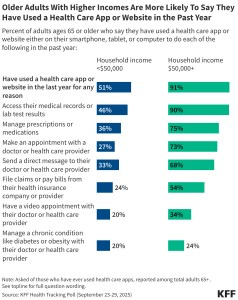
The conventional wisdom used to be that seniors would be slow to adopt new digital health technologies. Many seniors were not online. Or many struggled with various cognitive issues. Or they’re not tech savvy. Or they’re suspicious of apps and AI. I wondered how much things had changed when CMS announced the new initiative to “make health tech great again.”

A lot has changed, according to results from the first of KFF’s survey series of the public and seniors about their use of, and appetite for, digital health tech. Possibly COVID forced America’s seniors to get on a steep tech learning curve. Possibly their kids have educated them. Or maybe seniors have simply aged into tech or adapted to new technologies to survive, as they’ve had to do to deal with their cell phone company and streaming service—what choice do they have?

From this survey, we found that the vast majority of seniors are using digital health tools and are interested in making greater use of it to navigate the health care system and manage health care needs. We didn’t find a meaningful difference between “younger” and “older” seniors, although we couldn’t look at the very old with this survey sample. And most Medicare beneficiaries (81%) say it’s important for Medicare to make it easier for them to share information between their providers or make apps more available to manage chronic conditions (63%), which are goals of the CMS initiative.

About 8 in 10 Medicare beneficiaries ages 65 and older used a health care app or website in the last year, and a sizable majority said it made it easier to use the health system. Half of them use multiple apps (55%). And there was no difference in the share of those 65 years or older who used an app or website to help manage their care in the last year (77%) and 30–49-year-olds (76%).

There were, however, sizeable differences between higher and more moderate to lower income seniors in their use of digital health tech—maybe not surprising but important.  These differences may reflect sources of care, internet access, and many other factors, but they also mean that there will be real disparities in the use of digital health tools unless concerted efforts are made to level the playing field. As I attend conferences on digital health tech and AI, I hear a lot about how these tools might transform research, or diagnosis, or reduce physician burnout, or create business opportunities. I hear very little discussion of how digital health tech may actually assist patients (credit to the CMS initiative for that, whether you think it will succeed or not), and virtually no discussion of the challenges of reaching lower income populations or of integrating new digital technologies into public programs to improve access and health (except recently to determine eligibility for Medicaid work requirements). Possibly I am attending the wrong conferences.


There were also some very big holes in seniors’ use of digital health tools. Relatively modest shares of older Medicare beneficiaries have used an app or website for a video visit in the past year (just 30%). That was surprising. Even fewer have used it to help manage a chronic condition (23%), a major goal of health tech proponents. These are areas to watch and, if you are pushing this stuff, to work on.

And some Medicare beneficiaries do face real barriers to using tech: 17% have cognitive or mental impairments.

To be fair, we didn’t ask Medicare beneficiaries if they still preferred “old school” human contact to apps like MyHealth. These days, you message a care team; they message you back. That’s how you “talk to your doctor.” Many younger adults prefer urgent care centers to what now passes for “meaningful” interaction with your care “team.”

Our survey also found some significant obstacles to more rapid and widespread adoption of digital health tech by seniors, and one is especially significant: AI looms large in plans to expand digital health tech, but only 31% of Medicare beneficiaries ages 65 and older trust AI “a great deal” (8%) or “a fair amount” (23%) to access medical records and provide personalized information and advice. Public trust in AI tools to make appointments or send messages or access medical records is generally low.  And both the general public and seniors are worried about the privacy of health information controlled by government, tech companies, or insurance companies (hospitals fare better, but still half of the public overall are worried about the privacy of the health information they manage).

Digital health tech is not the solution to the more basic and most important problems facing the health system. One of my tasks when I was a kid in Boston was to shovel the snow from the driveway so my dad, an internist at what is now BI/Deaconess, could make house calls in the middle of the night. Today, many people can’t find primary care providers at all or get appointments with them. House calls, of course, are long forgotten.  Many can’t afford medical care or pay their medical bills, especially people who need a lot of care because they have a chronic illness or a major disease. But apps and other kinds of tech can play a role in making a fragmented and almost hopelessly complex system more navigable for patients. Apparently, as our survey findings suggest, a lot of Medicare beneficiaries—but not all beneficiaries equally—are ready for more digital health tech, and, as I said earlier, have become tech savvy to survive.

Honey, Sweetie, Dearie: The Perils of Elderspeak

Elderspeak is a kind of baby talk sometimes used when speaking to older people, especially those living with dementia. Elderspeak is common and it’s alienating. Journalist Paula Span reports that in one study, nursing home staff used elderspeak in 84 percent of interactions with residents. She has suggestions for what to do about it.  KFF Health News posted Span’s column on May 9, 2025. Funding from the Silver Century Foundation helps KFF Health News produce articles (like this one) on longevity and related health and social issues.  

A prime example of elderspeak: Cindy Smith was visiting her father in his assisted living apartment in Roseville, CA. An aide who was trying to induce him to do something— Smith no longer remembers exactly what—said, “Let me help you, sweetheart.”

“He just gave her The Look—under his bushy eyebrows—and said, ‘What, are we getting married?’” recalled Smith, who had a good laugh, she said. Her father was then 92, a retired county planner and a World War II veteran; macular degeneration had reduced the quality of his vision, and he used a walker to get around, but he remained cognitively sharp.

“He wouldn’t normally get too frosty with people,” Smith said. “But he did have the sense that he was a grown-up and he wasn’t always treated like one.”

People understand almost intuitively what “elderspeak” means. “It’s communication to older adults that sounds like baby talk,” said Clarissa Shaw, PhD, a dementia care researcher at the University of Iowa College of Nursing and a co-author of a recent article that helps researchers document its use. “It arises from an ageist assumption of frailty, incompetence and dependence.”

Its elements include inappropriate endearments. “Elderspeak can be controlling, kind of bossy, so to soften that message, there’s ‘honey,’ ‘dearie,’ ‘sweetie,’” said Kristine Williams, PhD, a nurse gerontologist at the University of Kansas School of Nursing and another co-author of the article. “We have negative stereotypes of older adults, so we change the way we talk.”

Or caregivers may resort to plural pronouns: Are we ready to take our bath? There, the implication “is that the person’s not able to act as an individual,” Williams said. “Hopefully, I’m not taking the bath with you.”

Sometimes, elderspeakers employ a louder volume, shorter sentences or simple words intoned slowly. Or they may adopt an exaggerated, singsong vocal quality more suited to preschoolers, along with words like “potty” or “jammies.”

With what are known as tag questions—It’s time for you to eat lunch now, right—”You’re asking them a question but you’re not letting them respond,” Williams explained. “You’re telling them how to respond.”

Studies in nursing homes show how commonplace such speech is. When Williams, Shaw, and their team analyzed video recordings of 80 interactions between staff and residents with dementia, they found that 84 percent involved some form of elderspeak. 

“Most of elderspeak is well intended. People are trying to show they care,” Williams said. “They don’t realize the negative messages that come through.”

For example, among nursing home residents with dementia, studies have found a relationship between exposure to elderspeak and behaviors collectively known as resistance to care.

“People can turn away or cry or say no,” Williams explained. “They may clench their mouths shut when you’re trying to feed them.” Sometimes, they push caregivers away or strike them.

She and her team developed a training program called CHAT, for Changing Talk: three hour-long sessions that include videos of communication between staff members and patients, intended to reduce elderspeak.

It worked. Before the training, in 13 nursing homes in Kansas and Missouri, almost 35 percent of the time spent in interactions consisted of elderspeak; that share dropped to about 20 percent afterward.

Furthermore, resistant behaviors accounted for almost 36 percent of the time spent in encounters; after training, that proportion fell to about 20 percent.

A study conducted in a Midwestern hospital, again among patients with dementia, found the same sort of decline in resistance behavior

What’s more, CHAT training in nursing homes was associated with lower use of antipsychotic drugs. Though the results did not reach statistical significance, due in part to the small sample size, the research team deemed them “clinically significant.”

“Many of these medications have a black box warning from the FDA,” Williams said of the drugs. “It’s risky to use them in frail, older adults” because of their side effects.

Now, Williams, Shaw and their colleagues have streamlined the CHAT training and adapted it for online use. They are examining its effects in about 200 nursing homes nationwide.

Even without formal training programs, individuals and institutions can combat elderspeak. Kathleen Carmody, owner of Senior Matters Home Health Care and Consulting in Columbus, OH, cautions her aides to address clients as Mr. or Mrs. or Ms., “unless or until they say, ‘Please call me Betty.’”

In long term care, however, families and residents may worry that correcting the way staff members speak could create antagonism.

A few years ago, Carol Fahy, PhD, was fuming about the way aides at an assisted living facility in suburban Cleveland treated her mother, who was blind and had become increasingly dependent in her 80s.

Calling her “sweetie” and “honey babe,” the staff “would hover and coo, and they put her hair up in two pigtails on top of her head, like you would with a toddler,” said Fahy, a psychologist in Kaneohe, HI.

Although she recognized the aides’ agreeable intentions, “there’s a falseness about it,” she said. “It doesn’t make someone feel good. It’s actually alienating.”

Fahy considered discussing her objections with the aides, but “I didn’t want them to retaliate.” Eventually, for several reasons, she moved her mother to another facility.

Yet objecting to elderspeak need not become adversarial, Shaw said. Residents and patients—and people who encounter elderspeak elsewhere, because it’s hardly limited to health care settings—can politely explain how they prefer to be spoken to and what they want to be called.

Cultural differences also come into play. Felipe Agudelo, PhD, who teaches health communications at Boston University, pointed out that in certain contexts a diminutive or term of endearment “doesn’t come from underestimating your intellectual ability. It’s a term of affection.”

He emigrated from Colombia, where his 80-year-old mother takes no offense when a doctor or health care worker asks her to “tómese la pastillita” (take this little pill) or “mueva la manito” (move the little hand).

That’s customary, and “she feels she’s talking to someone who cares,” Agudelo said.

“Come to a place of negotiation,” he advised. “It doesn’t have to be challenging. The patient has the right to say, ‘I don’t like your talking to me that way.’”

In return, the worker “should acknowledge that the recipient may not come from the same cultural background,” he said. That person can respond, “This is the way I usually talk, but I can change it.”

Lisa Greim, 65, a retired writer in Arvada, CO, pushed back against elderspeak recently when she enrolled in Medicare drug coverage.

Suddenly, she recounted in an email, a mail-order pharmacy began calling almost daily because she hadn’t filled a prescription as expected.

These “gently condescending” callers, apparently reading from a script, all said, “It’s hard to remember to take our meds, isn’t it?”—as if they were swallowing pills together with Greim.

Annoyed by their presumption, and their follow-up question about how frequently she forgot her medications, Greim informed them that having stocked up earlier, she had a sufficient supply, thanks. She would reorder when she needed more.

Then, “I asked them to stop calling,” she said. “And they did.”

Fraud in Marketplace Enrollment and Eligibility: Five Things to Know

KFF Health News” coverage of longevity and our aging society is supported in part by The Silver Century Foundation.

Authors: Kaye Pestaina, Rayna Wallace, Michelle Long, Meghan Salaga, and Emma Lee

This analysis was updated on July 11, 2025, to reflect enactment of the 2025 budget reconciliation law, which was signed into law on July 4, 2025, and the changes it makes to ACA Marketplace standards.

Rooting out fraud has been one of the primary reasons given for changes to ACA Marketplace enrollment and eligibility standards included in the Trump administration’s final Marketplace integrity and affordability rule (“final regulation”), and in the recently enacted budget reconciliation law. In the final regulation, the Centers for Medicare and Medicaid Services (CMS) points to “dramatic levels of improper enrollment” in Marketplace plans that CMS says have involved fraudulent actions by some agents, brokers, and web brokers. The final regulation and the budget reconciliation law seek to address alleged fraud by instituting new standards for consumers to enroll in Marketplace coverage, from additional paperwork requirements to “verify” a consumer’s estimated household income to obtain advanced premium tax credits (APTC) to significant new administrative steps and new payments for consumers to continue Marketplace coverage. Few changes are made in the final regulation concerning oversight of entities alleged to have engaged in fraudulent activities, and none are included in the budget reconciliation law.

This brief explains what is known about fraud and improper enrollment in ACA Marketplace plans and what the final regulation and budget reconciliation law will do to change current Marketplace enrollment and eligibility standards.

1. The Affordable Care Act (ACA) gives the federal government broad authority to combat Marketplace fraud, alongside existing state oversight of private health insurance.

The Affordable Care Act (ACA) gives the Secretary of the Department of Health and Human Services (HHS) the authority to determine appropriate activities to reduce fraud and abuse in the administration of Marketplaces and to investigate Marketplace activity, “in coordination with” the Inspector General (OIG) of HHS. The HHS Secretary oversees these functions through the Center for Medicare and Medicaid Services (CMS), with at least two CMS offices involved in combating ACA fraud—the Center for Consumer Information and Insurance Oversight (CCIIO) and the Center for Program Integrity (CPI). These agencies, along with the HHS OIG, have a role in protecting the financial and program integrity of ACA programs. The Department of Justice litigates civil and criminal actions involving alleged health care fraud and abuse.

Fraud oversight is just one part of these agencies’ program integrity functions. These agencies are charged with protecting government resources, as well as program beneficiaries (consumers), by making sure that enrollment and required government payments are accurate and provided without delay. This involves ongoing audits of actors involved in the administration of Marketplaces and oversight of all individuals involved in ACA Marketplace enrollment and eligibility—from the agencies that run the program, to consumers and insurers, as well as those who assist in enrolling consumers, from agents and brokers to Navigators.

Improper enrollment or improper government payments of federal subsidies are fraudulent only if there is an intentional act to deceive or misrepresent facts in order to enroll or receive these benefits. The ACA does not have its own definition of “fraud” specific to Marketplace plans, but agencies can look to existing definitions that have been part of Medicare and Medicaid program integrity standards for some time.

In addition to this broad authority to oversee program integrity in the Marketplace, the ACA provides that if an applicant for Marketplace coverage or subsidies “knowingly and willfully” provides false or fraudulent information, the applicant may be subject to a civil penalty of up to $250,000 (smaller penalties apply where a consumer negligently provides false information in applying for Marketplace coverage). The civil penalty extends to “any person,” including an agent or a broker that directly provides false or incorrect information related to a Marketplace enrollment. In addition, any person who receives information from a Marketplace applicant in order to apply for coverage is subject to a civil penalty if they do not keep this information confidential.

The ACA also states that any payments made in connection with Marketplaces are subject to the False Claims Act if these payments include any federal funds. The False Claims Act is a century-old law that is designed to prevent and punish any individual or organization that defrauds the federal government. This could include circumstances where an individual intentionally presents, or causes to be presented, a false or fraudulent claim to the federal government. The ACA increased the penalties available for False Claims Act violations.

Marketplaces were created by the ACA as a platform for individuals to enroll in private insurance coverage and to apply for income-based federal subsidies. While the coverage is private—making it different from the public programs like Medicare and Medicaid, Marketplaces rely on federal dollars to (1) pay for and administer advance premium tax credits (APTCs) and cost-sharing reductions (CSRs) that help most enrollees pay for coverage, and (2) fund the agency, CMS, that runs the federally-facilitated Marketplace (FFM) (HealthCare.gov) for the states that elect not to operate their own Marketplace. CMS, along with the Internal Revenue Service (IRS) (part of the Treasury Department), set up a complex process to determine who is eligible for Marketplace coverage and financial assistance.

Oversight of these processes and the extent of each federal agencies’ authority to police the program at the federal level is still developing, as federal regulators and enforcers interpret and implement existing requirements. Recent federal activity in this area is discussed below.

The federal government functions exist alongside state oversight. States are the primary regulators of the private insurance coverage available in the Marketplaces and 20 states run their own Marketplace. As a result, each state has its own parallel authority to oversee the integrity of the programs they run and have their own fraud and abuse authority to deal with bad actors in the system, including insurers and those that sell insurance for these insurers, such as agents and brokers. As discussed below, states license the agents and brokers that sell Marketplace coverage.

2. Improper enrollment in Marketplace coverage and subsidies is not the same as fraud.

The ACA contains a unique structure for determining eligibility for Marketplace coverage and for eligibility for financial assistance (APTCs and CSRs). Eligibility is largely determined based on the projected household income of a consumer for the coming year—not on the consumer’s past or current income. Specifically, at open enrollment in the fall before the January 1 coverage year, the consumer is asked to estimate what their household income will be in the coming year.

In addition to open enrollment, there are limited special opportunities for individuals to enroll in Marketplace plans during the coverage year. These “special enrollment periods,” or SEPs, allow individuals to enroll in Marketplace coverage and obtain APTCs during the year if they meet specific criteria. Determining eligibility for SEPs also requires consumers to make an educated guess (estimate) about what their total annual household income will be at the end of the year.

Consumers, especially those with low incomes, often face difficulty predicting future income. KFF analysis found that individuals, especially those with low wages and unstable work, experience significant swings in income throughout the year. For those near poverty, predicting annual income may be especially difficult. Many people with incomes just above poverty at the beginning of the year end up below the federal poverty level (FPL) by the end of the year, and conversely, many who start out with incomes below poverty end up with incomes above poverty. Three in five (61%) people with starting incomes below poverty end the year with an income more than 20% different than their income during the first three months of the year. People with incomes below poverty ($15,060 for a single person in 2025) are not eligible for premium tax credits.

In setting up the Marketplace enrollment structure, Congress recognized that an individual’s annual income might end up being higher or lower than what they estimated when they applied for coverage. This difference could mean that a consumer appears to be “improperly enrolled” in Marketplace coverage or “improper payments” of Marketplace subsidies are paid by the federal government, even though the consumer did not intend to deceive or misrepresent their income. Recognizing this possibility, Congress provided for a process to “reconcile” APTC payments at the end of the year, once a consumer’s actual household income is known.

This is how the process works now: If a consumer is eligible for an APTC, these payments are made by the IRS directly to the insurer of the Marketplace plan that the consumer selects. The consumer does not directly receive these APTCs. If an individual’s actual household income at the end of the year was higher than the consumer estimated, the IRS may have paid too much money on behalf of the consumer to the insurer for APTCs. As a result, the consumer must “repay” the IRS the excess premium tax credit when the consumer files their income tax. Congress included provisions in the ACA that prohibit the federal government from requiring individuals below certain income levels to pay the full amount of excess premium tax credits (often referred to as “repayment limits or caps”). The example below illustrates how this works under current law:

Carla is a 27-year-old rideshare driver in Florida who also does seasonal work throughout the year. She estimated her 2024 income at $27,000 (179% of the FPL) and a $3,136 advance premium tax credit (APTC) was applied for Carla to purchase a benchmark Silver plan with a monthly premium of $3,595. She ended up working more that year than she initially expected, and as a result, she earned $37,650 (about 250% FPL), higher than what she estimated it would be. When filing taxes in 2025, she finds out that she should have received only $2,089 in APTC based on her actual income, meaning that her insurer was paid $1,047 more than Carla was eligible for in APTC. Due to her low income, however, Carla is not required to pay the full $1,047 to the IRS. Under repayment caps, Carla pays $950.

In this example, although Carla’s insurer received more APTC amounts than it should have, Carla did not intentionally underestimate her expected income (engage in fraud) in order to gain undue tax credits. She made an estimate that was reconciled at the end of the year when her actual household income was known, following the process Congress created in the ACA. The budget reconciliation law eliminates the repayment limits.

 Agents and brokers are state-licensed professionals who sell health insurance and assist consumers with selecting and enrolling in a health plan. Agents and brokers generally receive commissions from health insurance companies for enrolling individuals in health plans. A “web broker” is an individual or group of agents, brokers or business entities registered with the federal Marketplace that “develops and hosts” a non-Marketplace website that interfaces with the Marketplace to assist consumers with direct enrollment in Marketplace plans. Accusations of fraud have involved actions by these entities to fraudulently enroll consumers in Marketplace coverage in order to obtain commission payments from insurance companies. These fraudulent enrollments typically involve one of the following scenarios:

  • Unauthorized Enrollment: Enrolling an individual in Marketplace coverage without their consent
  • Unauthorized Switching: Switching an individual already enrolled in a Marketplace plan to another Marketplace plan without their consent

Brokers have played a large part in the Marketplace enrollment surge in recent years (Figure 1). According to KFF analysis of CMS data, during open enrollment for the 2021 plan year, brokers assisted 55% of active plan selections in HealthCare.gov states, increasing to 78% for 2024. Approximately one in five of all HealthCare.gov enrollments were “passive” (automatic) re-enrollments during these years (21% for 2021-2023, and 22% for 2024). We do not know how many of those who were automatically re-enrolled may have been assisted by a broker at some point during open enrollment. Broker-assisted enrollment data from 2016 to 2020 are among all HealthCare.gov enrollments, including automatic re-enrollments, so are not directly comparable with the 2021-2024 data. For context, however, 40% of all HealthCare.gov enrollments in 2016 were broker-assisted.

Between January 2024 and August 2024, CMS received 183,553 complaints of unauthorized enrollments, and 90,863 complaints of unauthorized switching of plans sold on the FFM (HealthCare.gov). CMS suspended 850 brokers for reasonable suspicion of fraudulent or abusive behaviors related to unauthorized plan switches and unauthorized enrollments between June and October 2024. Some of the entities suspended were web brokers approved and registered by CMS to host an application for Marketplace coverage on their own websites through processes called direct enrollment (DE) and enhanced direct enrollment (EDE). These functions are discussed below.

CMS took action to resolve the complaints, putting safeguards into place to protect consumers from broker fraud. For example, CMS announced that starting in July 2024, it would block agents and brokers from modifying a consumer’s HealthCare.gov enrollment unless the agent or broker has already assisted the consumer with enrollment in the past. Also, agents and brokers must enter into a three-way call with consumers and the Marketplace Call Center when trying to make changes to an account they are not already associated with.

Fraud allegations brought wide-ranging reactions from Congress in the summer of 2024. Some House Republican leaders called for further investigation, alleging that recent legislative and regulatory changes made to Marketplace rules (specifically, enhanced APTCs and Biden-era regulations aimed at reducing barriers for consumers signing up for Marketplace coverage) created incentives that encouraged Marketplace fraud. Democratic Congressional leaders, on the other hand, introduced legislation aimed at improving oversight and accountability for agents, brokers and marketing entities that engage in fraud.

Consumers sued brokers alleging fraudulent enrollment. In April 2024, consumers (and some brokers) brought class action litigation against specific brokers, web brokers, and marketing companies that generate sales leads (called “lead generators”) alleging, among other things, that the unauthorized switching and enrollment were part of a widespread scheme to obtain broker commissions that resulted in harm to enrollees and to brokers that originally placed an enrollee in coverage before the switch. While the case has since been dismissed, the plaintiffs alleged that the parties involved “created, sold, purchased and/or financed the purchase of leads that deceived consumers into thinking that they would receive cash cards and other cash benefits.” Leads include information such as consumer names and contact information that agents and brokers use to generate business. Many individuals and groups are in the business of lead generation and are not themselves licensed as agents and brokers. They sell or provide this information to those licensed to sell insurance.

How the alleged scheme worked: The complaint alleged a complicated scheme involving multiple parties. Marketing agencies and other individuals developed social media ads that falsely offered free cash rewards. Consumers that clicked on the ad were brought to a landing page where they were asked to provide specific information with the promise of cash. This information was captured and sold to agents and brokers who, using an enhanced direct enrollment platform, enrolled consumers in Marketplace coverage without their knowledge or switched their existing coverage to another plan.

Some brokers involved in the case brought an action against the federal government. In August 2024, TrueCoverage, LLC and Benefitalign LLC, two of the entities that had been sued in the April 2024 litigation and that had been suspended from the ACA Marketplaces, sued HHS and CMS after they were blocked for engaging in conduct that “compromised and placed consumers’ personally identifiable information (“PII”) and the integrity of the Exchanges at risk.” The case was dropped by the plaintiffs in October 2024, following a court decision denying the plaintiffs’ request for emergency relief. The court found that current regulation permits CMS to suspend direct enrollment entities based on “circumstances” that pose a “risk” that is “unacceptable.” Proof that systems have been compromised is not required.

Many suspended brokers were reinstated in 2025, according to CMS. It was reported that by March 2025, CMS had reinstated at least some of the brokers that had been suspended. It is not clear whether the reinstated brokers had demonstrated to HHS that they had remedied the cause of the suspension, as required in a regulation finalized by the Biden administration in January 2025. In June 2025, CMS released a Frequently Asked Questions (FAQs) document related to the removal of more than 1,000 brokers from its agent/broker suspension and termination list.

While these fraud allegations received nationwide attention in 2024, federal investigations of agents and brokers date back to at least 2018 (before the availability of enhanced APTCs and the Biden administration’s enrollment changes). Law enforcement action against agents and brokers include allegations of activity as far back as 2018. For example:

  • The Justice Department, in February 2025, charged two individuals with intentionally enrolling consumers in fully subsidized Marketplace plans between 2018 and 2022 that they were not eligible for in order to obtain commission payments. The indictment alleges that the individuals used misleading and deceptive sales tactics that targeted low-income individuals and provided false addresses and social security numbers. The trial is scheduled for later this year.
  • Another recent Justice Department indictment alleges similar activity dating back to 2019.
  • Annual HHS/DOJ reports on health fraud and abuse enforcement note investigations of agents and brokers going back to 2019. For example, the annual report on fraud enforcement activity for FY 2019 noted that CMS “reviewed cases of agent and broker misconduct and took administrative actions including terminating CMS’s agreements with agents and brokers and imposing civil monetary penalties on those agents and brokers who were found to have engaged in misconduct.” An FY 2023 report stated that CMS had received over 73,000 consumer complaints involving such misconduct as consumers being enrolled in federal Marketplace policies without their consent. That year, CMS “conducted over 80 investigations of outlier and high-risk agents and brokers, and made recommendations for administrative action, including suspension and termination of an agent’s and/or broker’s registration to sell policies on the FFM.”

4. Agents and brokers (including web brokers) who assist in Marketplace enrollment are regulated by both the federal government and states. 

Clearing the pathway to allow brokers to assist consumers to enroll in Marketplace plans aligns with an ACA goal to increase consumer access to comprehensive health coverage. However, the history of broker-related fraudulent enrollment activity points to the importance of oversight of these entities. This not only protects consumers but also ensures that brokers operating in good faith with adequate control and accountability for the third parties that assist them can still provide enrollment help for Marketplace consumers. Both the federal government and states have authority to regulate agents and brokers.

Federal Marketplace oversight related to brokers’ conduct has developed over time aimed at protecting consumers from fraud, as well as preventing deceitful marketing practices and other potentially harmful conduct. The ACA requires the Secretary of HHS to establish procedures where States may allow agents and brokers to enroll individuals in Marketplace plans and assist them in applying for Marketplace subsidies. With this authority, CMS has developed and continues to update requirements agents and brokers must meet in order to assist consumers to enroll in Marketplace coverage. CMS has developed a framework that is different from CMS agent and broker requirements for Medicare Advantage plans. In Medicare Advantage, the insurers have a legal responsibility to ensure agents and brokers comply with federal (and state) requirements. For Marketplace plans, CMS has set standards to regulate agents and brokers directly, without accountability flowing through the insurers that hire them.

In the early years of ACA Marketplace regulation, rules largely included in annual CMS regulations added a range of requirements including a process for broker termination and suspension, standards for the display of Qualified Health Plan (QHP) information and disclaimers that must be posted when certain QHP information is not available, and standards of conduct for agents and brokers selling plans on the FFM.

New technology allows more consumers to enroll in Marketplaces but raises new concerns. “Direct Enrollment” (DE) is a process that allows insurers and web brokers to enroll consumers in coverage directly from their websites. Initially, the direct enrollment pathway allowed the consumer to start the process on a web broker’s own website, but then had to be redirected back to HealthCare.gov to complete the eligibility application before returning to the web broker site to select a plan. Improved technology has added new enrollment pathways that allow agents and brokers to complete the entire eligibility application and enroll consumers in coverage on their own third-party website platforms, without being redirected to HealthCare.gov. This process is known as “Enhanced Direct Enrollment” (EDE).

Although EDE was praised for its potential to increase HealthCare.gov enrollments, as with any new technology, there are and continue to be concerns about privacy and security of consumer information, the potential for fraud, and the possibility that EDE could lead to consumers receiving inaccurate or misleading information that might affect eligibility determinations and consumer choice. In March 2016, CMS announced its intent to implement this new enrollment pathway in the federally-facilitated Marketplace but delayed implementation of the EDE pathway until 2018 and added new safeguards, including a process for HHS-approved third-party entities to periodically monitor and audit agents and brokers using the DE or EDE pathways.

Use of EDE begins and grows; CMS makes further changes to agent and broker standards. The Trump administration expanded the use of the EDE pathway for the federal Marketplace with CMS’s approval of its first Enhanced Direct Enrollment partner, HealthSherpa, in December 2018.

  • CMS reported that DE and EDE pathways were utilized for 37% of all active HealthCare.gov plan selections during 2021 open enrollment, up from 29% during 2020 open enrollment, attributing its growth to increased use of the EDE pathway. The EDE process has historically only been available in HealthCare.gov states; however, in 2024, Georgia became the first state-based Marketplace (SBM) to partner with EDE entities.
  • HealthSherpa reported that more than 95% of total EDE enrollments came through its EDE implementations during the 2021 open enrollment.
  • CMS implemented Help On Demand, a referral service allowing consumers using HealthCare.gov to request enrollment assistance from licensed agents and brokers.
  • CMS added new requirements specific to issuers, agents, and brokers as direct enrollment grew. In 2019, the Trump administration rescinded a requirement that only HHS-approved auditors conduct third-party audits of these entities, allowing issuers, agents, and brokers to choose their own auditors.

Continuing consumer complaints of unauthorized agent and broker enrollment resulted in further changes to agent and broker oversight. Regulations issued during the Biden administration updated agent and broker oversight requirements, including:

  • In 2023, to address enrollments done without consumer consent, CMS established new requirements that require agents, brokers, and web brokers in the federal Marketplace to verify that the eligibility application information they collected has been reviewed and confirmed by the consumer before submission. Receipt of the consumer’s consent has to be documented by agents, brokers, and web brokers.
  • To clarify the reach of federal enforcement against agents and brokers, standards finalized in January 2025 allow CMS to hold “lead agents”—typically executives or others in leadership of broker agencies –accountable for misconduct or noncompliance that they direct or oversee.
  • CMS clarified its authority to take immediate action to suspend a broker’s or agent’s access to the DE and EDE pathways and their ability to transmit information to the Marketplace when circumstances pose an “unacceptable risk” to enrollees, the accuracy of the Marketplace’s eligibility determinations, or the Marketplace’s information technology systems.

States also oversee insurance agents and brokers. Agents and brokers are required to be licensed in every state where they sell health insurance and are also required to complete the CMS Agent and Broker Federally-facilitated Marketplace (FFM) registration to sell Marketplace plans. To further combat fraud and other deceptive practices, the National Association of Insurance Commissioners (NAIC) reports that every state and the District of Columbia (DC) has made insurance fraud a crime for at least some lines of insurance, and 42 states and DC have insurance fraud bureaus that investigate claims of illegal insurance activities and work to prosecute insurance fraud. The NAIC’s model state law, Unfair Trade Practices Act (Model 880), which describes activities considered “unfair or deceptive acts or practices” in the insurance industry, has been adopted in some form by 45 states and the District of Columbia.

States that operate their own Marketplaces currently have considerable flexibility to establish additional policies and procedures in their Marketplaces for agents and brokers. States can go beyond the requirements set out in federal regulations for oversight. For example, Idaho’s SBM stated that its online platform requires multi-factor authorization and only consumers can add an agent to their account. Massachusetts’s SBM does not use brokers nor does it permit EDEs to enroll consumers. California’s SBM requires that agents be specifically added by the consumer through their consumer portal (or consent can be verified through a three-way call), and consumers can edit and remove permissions on that portal.

Some states have been proactive in law enforcement actions related to Marketplace agent and broker fraud. For example, Massachusetts and California took action related to fraudulent Marketplace enrollments concerning a scheme involving substance use disorder treatment centers a few years ago. Although there have been allegations of Marketplace broker fraud in Florida in recent years, information on recent enforcement activity by the state is not available.

5. Final regulation and budget reconciliation law introduce new paperwork and other enrollment requirements for Marketplace consumers but make few changes to broker oversight.

In the final Marketplace Integrity and Affordability rule, released on June 20, 2025, CMS says that Marketplace fraud occurred due to the widespread availability of zero-dollar out-of-pocket premium plans following the implementation of enhanced premium tax credits and enrollment policy changes during the Biden administration. The final regulation introduces many significant changes to Marketplace enrollment standards, verification processes, and documentation requirements. Some of these changes apply to both the federal Marketplace and state-based marketplaces and many will expire at the end of the 2026 plan year. The 2025 budget reconciliation law includes some related provisions (without an expiration date) as well as some additional enrollment and eligibility changes.

The final regulation addresses concerns about fraud in the Marketplace primarily by implementing stricter consumer-facing verification and eligibility procedures as well as by limiting enrollment opportunities. Some examples of the provisions include:

  • Requiring Marketplaces to generate a data matching inconsistency if a consumer estimates that their income will be between 100% and 400% of the FPL (between $15,650 and $62,600 for a single person in 2025), but IRS data or other data sources show their past income was below 100% of the FPL. Takes effect in August 2025 and expireat the end of the 2026 plan year.
  • No longer requiring Marketplaces to accept an applicant’s or enrollee’s estimate of projected household income when tax return data is unavailable. Under the regulation, Marketplaces will be required to confirm income with other data sources and require that applicants submit documentation that confirms their income. Takes effect in August 2025 and expires at the end of the 2026 plan year.
  • Removing the low-income SEP that allows low-income consumers to enroll in a Marketplace plan during the year if their estimated income is no more than 150% of the FPL ($23,475 for a single person in 2025). Takes effect in August 2025 and expires at the end of the 2026 plan year (see similar, permanent provision below). 
  • Requiring consumers in FFM states who are automatically re-enrolled in a $0-premium plan (because tax credits fully cover their premium) to confirm or update their eligibility during Open Enrollment or face a $5 monthly charge. Applies to the 2026 plan year only and does not apply to SBM states.
  • Shortening the Open Enrollment period so that, for all Marketplaces, Open Enrollment must begin no later than November 1 and end no later than December 31. Begins with the 2027 Open Enrollment period and does not expire. 

Although there are some related provisions in the final regulation and the budget reconciliation law, the law contains several additional provisions related to eligibility and enrollment, which do not expire. For example, the law:

  • Removes APTC repayment limits and requires all enrollees, including those with low incomes, to repay the entirety of any excess premium tax credits that were paid to their insurer. Begins with the 2026 plan year.
  • Prohibits eligibility for APTCs for Marketplace consumers who qualify for special enrollment periods based solely on their income relative to the poverty level, beginning with the 2026 plan year.
  • Eliminates eligibility for APTCs for certain low-income, lawfully present immigrants by excluding individuals such as refugees, asylees, and survivors of human trafficking. Begins in 2027.
  • Establishes new requirements for consumers to verify specific information before they can receive APTCs. This provision could effectively end automatic re-enrollment for most Marketplace consumers. Consumers will still be permitted to enroll in a health plan while awaiting confirmation of eligibility, but they will not receive APTCs until after their eligibility is verified. Begins with the 2028 plan year. 

See this KFF analysis for additional details on the ACA-related provisions in the 2025 budget reconciliation law.

Changes include few reforms to agent and broker oversight. There is only one provision in the final rule that specifically addresses agents and brokers. The final regulation clarifies the standard that CMS must prove to terminate a broker contract as the “preponderance of the evidence” standard of proof. The rule defines “preponderance of the evidence” as proof by evidence that, when compared to opposing evidence, leads to the conclusion that the fact at issue is more likely true than not. This provision appears to be aimed at providing more transparency to agents and brokers about the standard the government will use to determine whether they have breached their contract with CMS or other standards of conduct agents and brokers are required to meet. No reforms to broker and agent oversight are included in the budget reconciliation law.


Choosing a Home That Cares 

Ted, now 73, was diagnosed with Alzheimer’s two years ago. His wife, Andrea, attends a caregiver support group I lead. 

Recently she told the group, “I know it’s early and my husband is far from needing a nursing home now, but when I read all this stuff about nursing homes being understaffed and giving terrible care, I swear I’ll never put him in one. But then I think of what you in the group have said—that I may reach a point where I simply can’t do it anymore. So then I think I better start looking now, because a good home is going to be almost impossible to find. It all makes me feel so hopeless, I don’t do anything.”

Andrea isn’t alone. The high death rate in nursing homes during the pandemic and their continuing staffing problems have a lot of families feeling more reluctant than ever to trust others with their loved one’s care.

It’s true that understaffing is widespread and makes finding good long term care harder, but it can be found. Here’s how to begin your search. 

Start early! When someone suffers from a dementing illness, a slow decline is likely, allowing enough time to find a good nursing home. But an unforeseen event—a stroke or an accident—can happen and could force you to make a quick decision. 

Think carefully about the kind of care your loved one needs. 

Three levels of long-term residential care are commonly available: skilled nursing, assisted living and memory care. 

Skilled nursing facilities are for people with medical problems who need the attention of registered nurses and certified nursing assistants. Some skilled nursing homes accept patients with dementia. Being medical facilities, they are regulated by federal rules. Inspections, however, fall to the state they’re in, and the thoroughness varies. Because skilled nursing requires a professional staff, it costs more than lower levels of care.

Assisted living homes serve people who need some assistance, for instance with bathing, dressing, medications or meals, but not total care. Many require the person entering to be able to walk and assist in some of their care. You need to carefully check the staff’s ability to give dementia care. 

Generally staffed by licensed practical nurses and certified nurses’ aides and often homier than skilled facilities, assisted living homes are not regulated by the federal government but only through state agencies—like the health department.

Memory Care is most often given in a unit that’s entirely for people with dementia. The care is similar to what residents get in assisted living, enhanced to provide what dementia requires. The label can mean many different things. It can indicate merely that they will accept people with dementia. Or it can mean they offer care in an environment designed specifically to ease the experience of those with cognitive decline and have a staff well-trained in dementia care. Usually, memory care amounts to something in between. 

When you consider placing your loved one anywhere, ask yourself, what do they need help with? What level of care do they need? Are there behaviors that you have learned to work around? You will want the assurance that the staff at a memory unit has been trained to handle that.

Because of the stigma associated with nursing homes, you may feel more comfortable telling people, “My mom’s in assisted living.” But if she needs skilled care—or memory care—she won’t get the kind of attention she needs in ordinary assisted living.

Find out whether a facility you’re considering is for-profit or nonprofit. The difference can have consequences for your loved one’s care.

For-profit homes more frequently make the news for gross negligence, due to putting earnings above adequate care. But there are exceptions. Two of the for-profit, memory-care units near where my support group meets are excellent. Much of their success comes from the fact that they were designed from the start for dementia care—from their physical layout to the training of their staff. 

Nonprofits are often mission driven, not motivated to make money for shareholders. Their mission might be to serve others; some have a religious affiliation. The mission of the excellent nonprofit organization Kendal is “to transform the experience of aging.”

Consider a home’s location and cost as you investigate your choices. Andrea began her search for eventual long term care for Ted right in the support group by asking the other members what determined which home they chose for their family member. Memory care was primary, followed by distance and cost.

Those are good measures to use as you start your search. Try to find a good place within 15 or 20 minutes of your house so it will be convenient to visit. I needed to travel 35 minutes to get to the excellent home I found for my mother, and that meant I visited two or three times a week rather than three or four. (I mention cost below.)

Your local Area Agency on Aging can give you a list of local facilities, as can the local chapter of the Alzheimer’s Association. Your state’s long term care ombudsman—an official advocate for residents in care homes—can at least steer you away from the worst facilities.

Visit residences that seem like good possibilities. Once you have several well-recommended homes that meet your needs regarding location and level of care, call them and speak to the person in charge of admissions, now usually called the director of marketing.

Verify that the facility gives dementia care and ask how their staff is trained to work with that population. To assess what they tell you, check the Alzheimer’s Association’s list of recognized training programs.

Ask about the cost and what is included. A top-notch, for-profit dementia care home is going to be expensive. Excellent care is sometimes given for less in nonprofit homes.

Find out if the rate increases as the resident needs more care.

Make an appointment to visit any homes that sound like good possibilities. Your visit will include a tour and a meeting with the marketing director, when you can ask all the questions you have. Unless you are under pressure to find a place, don’t do more than one in a day. You’ll need time to sort through what you have learned. Be sure to pay a second visit to any that you don’t reject on the first round. You can’t possibly see all that’s important in one visit.

You can find online check lists of what to look for and questions to ask on a nursing home visit, but the very best source is the book The 36-Hour Day: A Family Guide to Caring for People Who Have Alzheimer Disease and Other Dementias by Nancy L. Mace and Peter V. Rabins. Almost all libraries have a copy.

It has often been called the caregiver’s bible. A reference work, it covers almost everything a dementia caregiver might need to know. The only caveat is that it includes a lot you don’t need to know because there are lots of things that won’t happen to your loved one and you on this journey. It’s best for consulting when you have a question or a problem arises. 

There is no ideal care home. You will need to compromise. Your task is to find the best one available for your loved one.

An important part of your search will be learning what constitutes good dementia care. Once you know that, bad care won’t be hard to spot.

To be continued in my next blog, “At the Heart of Good Care.”

BE THE FUEL

MAKE A DONATION TODAY

Your generosity is truly the fuel that empowers CMAP to change lives and to help older adults discover their “why!”

We invite you to donate to the 2023–2024 Annual Giving Campaign by June 30 to help us reach our goal.