
Important Update: Temporary Closure of the Nancy S. Klath Center Due to water damage, the Nancy S. Klath Center (101 Poor Farm Road) is temporarily closed for construction. For your safety, please do not visit the building. We will share updates as soon as it is ready to reopen.

Medicare Beneficiaries Are Not Luddites

KFF Health News” coverage of longevity and our aging society is supported in part by The Silver Century Foundation.

The conventional wisdom used to be that seniors would be slow to adopt new digital health technologies. Many seniors were not online. Or many struggled with various cognitive issues. Or they’re not tech savvy. Or they’re suspicious of apps and AI. I wondered how much things had changed when CMS announced the new initiative to “make health tech great again.”

A lot has changed, according to results from the first of KFF’s survey series of the public and seniors about their use of, and appetite for, digital health tech. Possibly COVID forced America’s seniors to get on a steep tech learning curve. Possibly their kids have educated them. Or maybe seniors have simply aged into tech or adapted to new technologies to survive, as they’ve had to do to deal with their cell phone company and streaming service—what choice do they have?

From this survey, we found that the vast majority of seniors are using digital health tools and are interested in making greater use of it to navigate the health care system and manage health care needs. We didn’t find a meaningful difference between “younger” and “older” seniors, although we couldn’t look at the very old with this survey sample. And most Medicare beneficiaries (81%) say it’s important for Medicare to make it easier for them to share information between their providers or make apps more available to manage chronic conditions (63%), which are goals of the CMS initiative.

About 8 in 10 Medicare beneficiaries ages 65 and older used a health care app or website in the last year, and a sizable majority said it made it easier to use the health system. Half of them use multiple apps (55%). And there was no difference in the share of those 65 years or older who used an app or website to help manage their care in the last year (77%) and 30–49-year-olds (76%).

There were, however, sizeable differences between higher and more moderate to lower income seniors in their use of digital health tech—maybe not surprising but important.  These differences may reflect sources of care, internet access, and many other factors, but they also mean that there will be real disparities in the use of digital health tools unless concerted efforts are made to level the playing field. As I attend conferences on digital health tech and AI, I hear a lot about how these tools might transform research, or diagnosis, or reduce physician burnout, or create business opportunities. I hear very little discussion of how digital health tech may actually assist patients (credit to the CMS initiative for that, whether you think it will succeed or not), and virtually no discussion of the challenges of reaching lower income populations or of integrating new digital technologies into public programs to improve access and health (except recently to determine eligibility for Medicaid work requirements). Possibly I am attending the wrong conferences.
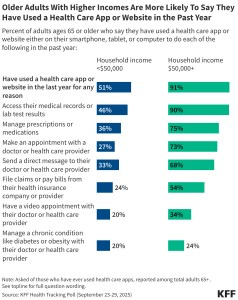
 

There were also some very big holes in seniors’ use of digital health tools. Relatively modest shares of older Medicare beneficiaries have used an app or website for a video visit in the past year (just 30%). That was surprising. Even fewer have used it to help manage a chronic condition (23%), a major goal of health tech proponents. These are areas to watch and, if you are pushing this stuff, to work on.

And some Medicare beneficiaries do face real barriers to using tech: 17% have cognitive or mental impairments.

To be fair, we didn’t ask Medicare beneficiaries if they still preferred “old school” human contact to apps like MyHealth. These days, you message a care team; they message you back. That’s how you “talk to your doctor.” Many younger adults prefer urgent care centers to what now passes for “meaningful” interaction with your care “team.”

Our survey also found some significant obstacles to more rapid and widespread adoption of digital health tech by seniors, and one is especially significant: AI looms large in plans to expand digital health tech, but only 31% of Medicare beneficiaries ages 65 and older trust AI “a great deal” (8%) or “a fair amount” (23%) to access medical records and provide personalized information and advice. Public trust in AI tools to make appointments or send messages or access medical records is generally low.  And both the general public and seniors are worried about the privacy of health information controlled by government, tech companies, or insurance companies (hospitals fare better, but still half of the public overall are worried about the privacy of the health information they manage).

Digital health tech is not the solution to the more basic and most important problems facing the health system. One of my tasks when I was a kid in Boston was to shovel the snow from the driveway so my dad, an internist at what is now BI/Deaconess, could make house calls in the middle of the night. Today, many people can’t find primary care providers at all or get appointments with them. House calls, of course, are long forgotten.  Many can’t afford medical care or pay their medical bills, especially people who need a lot of care because they have a chronic illness or a major disease. But apps and other kinds of tech can play a role in making a fragmented and almost hopelessly complex system more navigable for patients. Apparently, as our survey findings suggest, a lot of Medicare beneficiaries—but not all beneficiaries equally—are ready for more digital health tech, and, as I said earlier, have become tech savvy to survive.

The Balloon Ride

“After signing up for nine consecutive sessions of ‘Time to Tell Your Story,’ the memoir writing class led by Wendy Humphrey, I can say my life has been changed. I entered the class knowing only how to write for scholarly journals. Now I have a memoir in press that fills me with optimism and pride. Hail to CMAP.”

— Marilyn Aronberg Lavin, Class Member Since 2023


The Balloon Ride

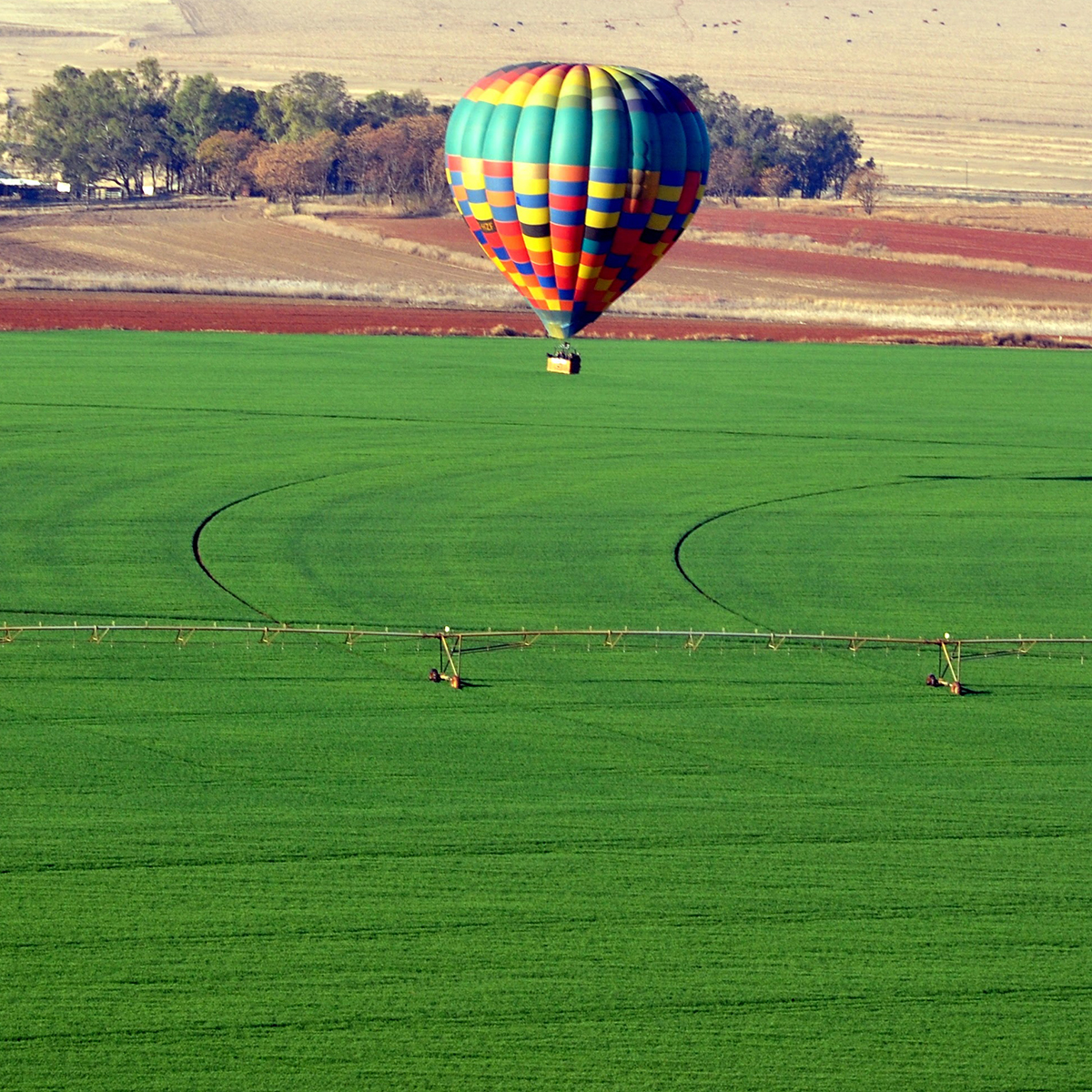
Approaching our twenty-fifth anniversary that summer, my husband Irving and I decided to celebrate with a party that would include a ride in a hot air balloon. I had read in the “Town Topics,” the weekly Princeton newspaper, about a local gentleman who would come to your house with all the necessary paraphernalia and take groups of people up about 500 feet, high enough to get a view of the neighborhood. The balloon would remain tethered to the ground so there was no chance of going higher or flying away. The contract covered twenty or so such elevations. It sounded like a fun idea, and certainly out of the ordinary, which we wished our friends and neighbors to believe was our style.

I called the number in the “Topics” and spoke directly to the pilot. Yes, he was a private company; and yes, he had the proper insurance. Since the price didn’t seem too outrageous, we spoke about dates and times. The party would be toward the end of the summer, near our anniversary (August 31), late afternoon-early evening while it was still light outside. There would be a letter of agreement and payment in advance. All was agreed upon and finalized. The party guest list included all the art history members of the coming semester plus a few outside friends. I planned to serve plenty of cocktails and a light, walk-around supper. I sent out invitations, including information about the planned entertainment.

When the day came, I was somewhat shocked to meet the balloonist. He was quite tall and thin and wore a black silk hat, a stiff white front shirt, black tails, and shorts that were black and white striped. Nevertheless, he was quite business-like and more than pleasant and I soon got over his bizarre appearance. He carried the huge, deflated balloon and his other equipment into the wide lawn of our backyard and started making preparations. When the guests began to arrive, I could tell their reactions were going to be quite varied. Some people took their drinks out the back door to watch the pilot at work. Some were rather blasé, pulling faces to imply they had seen all this before. Others seemed too preoccupied to look in the direction of the large, inflating balloon.

Soon the preparations for liftoff were complete. The first couples to volunteer were very excited and ready to climb into the basket. But at that very moment, by good fortune or bad, it began to rain. The balloonist frantically dismantled the equipment. The first couples ran inside, politely swearing under their breath as they sought their second drink. Other guests were looking disappointed. As it began to rain harder, others looked greatly relieved and started to enjoy the party. The balloonist took off his hat and shoes and joined the animated conversation that filled the house. And so the party changed in character, but was nevertheless a great success.

The result of all this enforced change of plan was that we were left with a paid-up but unfulfilled contract. The balloonist (whose name by now we knew was Alex) very responsibly suggested a way to fulfill what he thought we were owed. He suggested taking Irving and me on a real balloon ride. On the next fine-weather day, we would go up one thousand feet and fly for an hour in whatever direction the wind was blowing. He had a chase car (car and driver) that would follow us all the while and, after the balloon landed, would bring us back to our home. This proposition struck us as more than equitable and, although in my heart I was terrified, I could see that Irving was champing at the bit. So we agreed.

Alex returned with his equipment on the next bright and sunny day. We clambered into the basket wearing hats and sunglasses. We heard the swoosh of the great bag filling and watched the flame dance above the gas lamp as it heated the air. Sandbags were dropped, and up we went. As Irving chatted enthusiastically with Alex about the principles involved, I watched the ground recede as we rose higher and higher. Sounds of earth, traffic, and birds faded away, and the localization of scale slowly shifted into my own receding line of sight. Things on Earth were now becoming miniaturized, and the real center of the universe was in the balloon’s basket. We floated up over the Institute’s grounds and the golf course, then over to Alexander Street, the University campus, and on to Lake Carnegie. Over the water the air drew us up a bit higher, giving us a full view of the west end of Princeton and Route 1, the old Brunswick Pike. Irving and I were continually enthralled by the vista, breathlessly pointing out familiar places seen in a new perspective. It was as though time had stopped and, embraced in silence, the swoosh of the gas flame was the only language left in the world.

After about forty-five minutes, the wind shifted and changed our flight path toward the southeast. In a few moments, Alex said it would be best to land before entering the sphere of the three north-south highways that at this hour would be full of traffic. We were floating along somewhere between Route 1 and Highway 130 when he spied an empty patch of ground alongside a big cornfield. He began to pull on various ropes, edging the balloon in that direction, at the same time he was letting air out of the balloon. As we began to descend, it struck me that I had not researched hitting the ground in a basket without wheels. My panic continued to increase, and I cried out, “What do we do at the landing”? Alex roared back: “BEND YOUR KNEES.” As the earth came up to meet us, I grabbed the edge of the basket and instinctively timed my bend with the exact moment of contact. Irving must have done the same. After a bump and a few little hops, we came to a standstill. Alex looked pleased. Irving and I were surprised and relieved. We began to breathe more easily.

But not for long. In a matter of minutes, a huge man came running out of the farmhouse. He was accompanied by a big, black, barking, dog, and he was carrying a shotgun. He was also yelling and swearing malignantly and telling us to get the hell off his property. Alex suavely jumped out of the balloon basket carrying a bottle of champagne. With kind words and great apologies, he offered the wine to the man who would have none of it and kept yelling and waving his gun in the air. When he took aim, Alex leapt back into the basket, handed me the bottle, and began the re-inflation of the balloon. I looked down as we rose; my last vision was of the man still gesticulating, gun in the air, the dog still barking.

Once we were sufficiently high, Alex looked about for another place to land. The nearest open space turned out to be not too far away but on the other side of Highway 130, which was now filled with cars. The flat spot was the parking lot of a roadside filling station. Our second descent was nowhere near as idyllic as the first, but Alex’s expertise manipulated us into what was a fairly tight spot. At least now, Irving and I had become experts at bending our knees. We made quite an amusing sight: a half-filled balloon, three frazzled souls in a basket, among cars, trucks, and even a tractor. Luckily, the station had a telephone and bar. The chase car had lost us after our second take-off, and it took some time to explain our location to the driver. While waiting, we all had a beer and were glad to have it.

At home that night, in reviewing our day’s adventure, Irving and I decided we had gotten more than our money’s worth. We had seen and done things we could honestly call unique. All in all, it had been a bargain. We also agreed that we probably would not be repeating the exercise any time soon.

Theo of Golden

Atria Books

If you read just one novel from 2025, let it be Theo of Golden. Theo arrives in the small town of Golden as a mysterious, benevolent stranger and is quickly accepted by the locals. In the town café, he lingers over a wall of portraits depicting 92 people he doesn’t know and resolves to purchase and return the artwork to its subjects.

The story follows Theo through moments that appear simple—an unhurried conversation, a small kindness, a friendship that quietly takes hold—but resonate with surprising depth. We know little about him beyond his deep knowledge of the arts, yet through each portrait and its recipient, we see how fully he notices others. Before long, we’re invested in the tender ways people shape one another simply by showing up and being seen.

Reflective and character-driven, this novel offers cozy, small-town charm without veering into sentimentality. Theo of Golden is comforting without being sugary, hopeful without being preachy—a book to linger over and return to when you need reassurance about what matters most: connection, kindness and belonging.

BE THE FUEL

MAKE A DONATION TODAY

Your generosity is truly the fuel that empowers CMAP to change lives and to help older adults discover their “why!”

We invite you to donate to the 2023–2024 Annual Giving Campaign by June 30 to help us reach our goal.