
Important Update: Temporary Closure of the Nancy S. Klath Center Due to water damage, the Nancy S. Klath Center (101 Poor Farm Road) is temporarily closed for construction. For your safety, please do not visit the building. We will share updates as soon as it is ready to reopen.

CMAP remains fully operational. Staff are working remotely and from the Suzanne Patterson Building (45 Stockton Street). Programs will continue as scheduled at the Suzanne Patterson Building and in virtual formats. Thank you for your understanding.

Save on Health Care at the Playground

When Ronni Bennett discovered elder playgrounds online a few years ago, she immediately fell in love with the concept. She began researching how the outdoor parks, designed specifically for the social and fitness needs of older adults, have become popular in Asia and Europe. She interviewed designers and looked into the special equipment involved.

Bennett, 75, a retired web producer who writes an influential blog about “what it’s really like to get old,” began lobbying her city council to build an elder playground in Lake Oswego, OR, the town where she lives. She was successful: her community now has a fitness park with 10 pieces of equipment designed specifically for older adults, including three that are wheelchair-friendly.

But, claiming it would be impossible to enforce an “elders only” policy, Lake Oswego officials named the park “FIT Spot.”

Bennett blames ageism. “I am so sorry the word ‘elder’ is not in the name,” she said. “But that is how things go in a culture as terrified of aging as ours is. Nobody wants to say there are old people here.”

Bennett’s experience may help explain why elder playgrounds are taking off much more slowly in the United States than in other parts of the world. While interest is growing, only a handful of dedicated “elder playgrounds” have been installed in the United States. Convincing communities to give money and space to parks that are for elders only is proving to be a hard sell.

Roots in China

Elder playgrounds have been around for about 20 years in other countries. In 1995, with the adoption of the “Physical Health Law of the People’s Republic of China” along with an “Outline of Nationwide Physical Fitness Program,” China began building outdoor fitness centers geared to all ages. In 2003, the University of Lapland in Finland, partnering with manufacturer Lappset, designed and built a playground for elders for research. Around the same time, Japan began repurposing children’s playgrounds as “Nursing Home Prevention Parks,” with specialized workout stations and classes, in response to the nation’s aging demographics. The concept quickly spread to Germany, England, Spain and Canada.

Elder playgrounds typically feature low-impact exercise equipment designed for the specific fitness priorities of older adults, such as building balance, coordination and flexibility. Equipment is lower to the ground and equipped with seats or grips geared to people who might have limited mobility or strength.

Regular use of an elder playground can boost older adults’ physical fitness and help prevent illness. One study found improvements in balance, coordination and speed after just three months.

Some elder playgrounds have been built in the United States, and there are hopeful signs that more are on the way. Colin Milner, founder and CEO of the International Council on Active Aging (ICAA), notes that many manufacturers of outdoor playground and fitness equipment have added or expanded lines of equipment specifically for older adults in recent years.

“These companies don’t jump on board unless they feel there is a significant opportunity,” Milner said.

While ICAA hasn’t tracked elder playgrounds specifically, its 2015 survey of health clubs, senior centers, retirement communities and continuing care retirement communities (CCRCs) found that 21 percent planned to purchase outdoor exercise equipment by 2017. At the time of the survey, some 41 percent planned to add game courts by 2017, 38 percent intended to create outdoor fitness or exercise trails and 57 percent aimed to install walking trails or paths.

From Kids to Elders

Michael Cohen, a veteran designer of children’s playgrounds, first became intrigued with spaces devoted exclusively to older adults when he saw a Good Morning America report on a “pensioners’ playground” in Manchester, England. That led him to found Must Have Play, an Ithaca, NY-based design group exclusively focused on innovative playgrounds for older adults. He has designed several elder playgrounds for parks in US cities, but so far none have actually been built.

Cohen envisions elder playgrounds as places that offer more than a good workout. He’d like to see elder playgrounds promote play in forms suited for older adults’ abilities, with courts or equipment for sports like pickleball, paddle ball, bankshot basketball or bocce ball, and loaded with features like water elements, walking paths and game tables.

“Ideally, an elder playground is not just a place to exercise,” Cohen said. “It’s an inviting space where you’d want to spend time.”

In the United States, playgrounds that cater to multiple generations are catching on more quickly than those designed exclusively for older adults.

That’s what happened at Carbide Park, in Galveston County, TX, which added an elder playground in 2014. The park has become a favorite destination for field trips from three local senior centers. On days when the weather is not too hot, busloads of older adults arrive to enjoy the park, according to Julie Diaz, director of parks and cultural services for Galveston County.

“If they want to go outside, they know they can come here to exercise, to swing or just to sit and talk with other seniors,” Diaz said. “The elder playground provides the type of exercise they need, and it’s very specific to them.”

Some elder playgrounds have arisen as outdoor extensions of local senior centers, such as the fitness park at the Rockville (MD) Senior Center. Cohen says that’s a big plus—proximity to a senior center or a senior residence gives visitors access to clean bathrooms and a place to go for help in the event of emergency.

The Rockville park features equipment developed especially for the needs of older adults, according to Chris Klopfer, the center’s senior sports and fitness supervisor.

“The playground encourages functional training, which incorporates more than one muscle group at a time, and that helps them with their day-to-day function, so that they can stay healthy and strong and age in place,” Klopfer said. “In today’s society we rely on medication for different ailments. I think we need to continue to push in the direction of physical exercise.”

The Rockville playground’s equipment has hand grips on everything, so that older exercisers can stabilize themselves. If they do fall, a non-slip surface made from rubberized tires makes injuries less likely.

One local trainer regularly brings older adult clients to the park for workouts when the weather is good. One of the trainer’s clients, Ellie Rouff, 72, adjusted her workout schedule to allow for more sessions at the park.

“I’m still working in an office and sit at a desk five days a week, so if I can be outside, I love it,” Rouff said. She likes the fact that the equipment has usage instructions and allows her to do exercises she couldn’t otherwise. She can no longer do push-ups on the floor but can perform them on one of the machines.

Boosting Fitness

Research suggests that regular use of an elder playground can boost older adults’ physical fitness and help prevent illness. The University of Lapland studied one group of 40 people, ages 65 to 81, and found significant improvements in balance, speed and coordination after just three months of guided exercise (90 minute, once-a-week sessions) on an elder playground.

Increased fitness not only improves quality of life, it can also help keep the cost of health care down, ICAA’s Milner notes, citing a study that found that adults who do 90 minutes of cardio exercise a week can save $2,500 annually on health care.

“By age 80, 46 percent of Americans can’t lift 10 pounds,” Milner said. “If you can’t lift 10 pounds, that’s a precursor to moving into a nursing home. Just simply getting people outdoors five to 10 minutes can make a huge difference in their mental health, attitude, overall health and well-being.”

Elder playgrounds also promote social engagement, an important factor given that many older adults become isolated and lose social ties. Numerous studies have linked isolation with poorer health among older adults.

Cohen designs elder playgrounds with conversational seating, to make them inviting even to people who may not wish to exercise. The exposure to sunlight helps reduce vitamin D deficiency and may help older adults sleep better at night.

The Multigenerational Option

In the United States, playgrounds that cater to multiple generations, instead of being designed exclusively for older adults, are catching on more quickly than elder playgrounds. These multigenerational playgrounds offer features and equipment appropriate for children as well as older adults. To motivate more adults to take their kids to play more often, the nonprofit KaBOOM! has built more than 50 multigenerational playgrounds in the United States since 2012 through a partnership with Humana and the Humana Foundation. (To build the playgrounds, local communities apply for KaBOOM! grants, enlist funding partners and recruit volunteers.)

But while multigenerational spaces offer great benefits, they’re not designed exclusively with seniors’ needs in mind, Cohen said.

“In reality, many multigenerational designs tend to pay short shrift to the needs of older adults,” he said. Many are essentially children’s playgrounds with a walking path added nearby or a few exercise machines located in adjacent space.

Milner agrees. “Multigenerational can be a little bit intimidating to older adults,” he said. “The noise might be overbearing.” Children who play raucously can be overwhelming to those living with dementia and possibly a safety issue if the children are underfoot among adults with mobility issues.
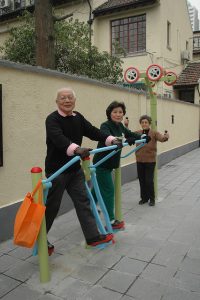
A study at Germany’s Wiesbaden Polytechnic indicated that many older adults found it embarrassing to exercise in the presence of younger people and were more inclined to use more private playground settings visited mostly by generational peers.

Another factor: some older people simply don’t feel comfortable around children. As a single, older man, Cohen says he’d personally feel uncomfortable on a playground and thinks some parents might feel that way too.

“I want a place where I can maybe meet a friend for a game of bocce, or where I can read,” he said. “I don’t necessarily want a lot of kids around.”

The Lake Oswego FIT Spot has naturally attracted some multigenerational use—it’s located near a children’s playground, so some grandparents and parents use the equipment while keeping an eye out as kids play nearby. But Ronni Bennett thinks it’s important to have dedicated spaces where elders, especially those who can’t afford a health-club membership, know they can meet peers and exercise comfortably and safely.

“With so much concern over health care costs, to me, elder playgrounds are a money-saving no brainer,” she said. “The point is to keep moving and to have fun at it. When people don’t exercise, they die younger than they should.”

Medical Tourism: Are Local Doctors Always the Best Choice?

Patients travel from around the United States and the world to see Richard Guyer, MD, an orthopedic spine surgeon at the Texas Back Institute in Plano, TX, because he is a recognized, widely published expert in disc-replacement surgery.

But when Guyer, 66, recently needed surgery himself—a complex procedure to remove a benign tumor—he flew to Florida. Good care was available in his own hospital, but he chose a surgery center where surgeons perform the procedure, on average, 50 times a week, using advanced techniques.

Guyer’s experience—both as sought-after surgeon and as traveling patient—is becoming more common. Proximity no longer determines health care. A growing number of Americans are willing to travel to other states or overseas as part of a trend called “medical tourism.”

Medical tourists travel to save money, to get cutting-edge or high quality care or for procedures not available locally.

Medical tourists leave home to access the best available care or to save money or, in some cases, both. Patients Beyond Borders, an information service for consumers, estimates that 1.7 million Americans will go overseas for elective medical care in 2017. The global medical tourism market is estimated to be $45 to $72 billion annually, with approximately 14 million patients crossing borders worldwide, including those who travel to the United States for medical care.

Data on domestic medical tourism—traveling within the United States to another state for health services—is scarce and largely anecdotal. But, noting a growing willingness to travel for care, physicians and medical centers are adjusting their practices to attract patients, particularly for out-of-pocket elective procedures.

What Sends Patients Packing

Within the United States, medical travel typically takes patients to centers of excellence for highly complex procedures, such as the Cleveland Clinic for heart surgery, or to research hospitals offering the latest and best care, such as Memorial Sloan Kettering Cancer Center.

Older Americans are driving the trend. Josef Woodman, CEO of Patients Beyond Borders, estimates that about 85 percent of overseas medical travelers fall within the ages of 45 to 65—too young to qualify for Medicare but at an age more likely to develop complex medical conditions.

Other drivers include the relatively inexpensive cost of travel and wide disparities in care and treatment pricing at home and abroad. Also, the Internet makes it easier for patients to research options and for providers at different locations to share medical records.

Gaps in health care insurance are also a factor, especially as a growing number of patients rely on health plans with high deductibles.

“As health plans continue to become more expensive and less cost-efficient for the patient, the ‘underinsured’ patient can often realize cost savings on more expensive surgeries over and above their plan reimbursement,” Woodman wrote in an email interview.

A 2012 study by Woodman, published in AARP International’s Journal, identifies three categories of medical tourists:

  • Value patients, usually those 50 and older, who are uninsured or underinsured or who seek procedures that insurance doesn’t cover
  • Access patients, who live in areas where available health care lacks quality or where specific procedures may not be available
  • Quality patients, who are willing to travel for exceptional specialty care, including cutting-edge surgeries or new therapies

Bill Ruth falls into the quality category. When the 64-year-old retired teacher and coach learned that he needed heart surgery, he called on a few physician friends for advice. They steered Ruth to the Cleveland Clinic or Baylor University Medical Center in Dallas, even though Ruth lives in Estes Park, CO. After researching his options and interviewing physicians, Ruth chose Baylor. He traveled to Dallas, where the procedure was successfully performed. Within a few days, Ruth was up and walking five miles at a time. And within a few weeks, he went to the high school in Pennsylvania, where he once taught, for his induction into the school’s athlete hall of fame.

Ruth’s insurance plan, through the teachers’ union, covered all of his medical costs; he picked up the cost of travel for himself and for his wife.

As a triathlete who organizes health and fitness programs in his community, Ruth said he would never consider just going to the nearest provider without doing his research.

Treatment abroad can be 20 to 80 percent less expensive, depending on the country and the procedure, and including the cost of travel.

“You want the best care possible,” he said. “Why shouldn’t people travel to get the best medical care?

“Some people put more research into buying a car (than medical care). But when you really care about your health and your activity level, you do what it takes to find the best care.”

Typically, for necessary procedures like Ruth’s, insurance will cover the treatment at most US locations, although often at out-of-network rates. (Be sure to confirm coverage with the insurance provider before any procedure.) Patients almost always pay the cost of travel.

But in some cases, medical travel is paid for by an employer. Home-improvement retailer Lowe’s sends employees in need of complex, non-emergency heart surgery to the Cleveland Clinic. Lowe’s, which self-insures its employees, struck deals for bundled prices with the Cleveland Clinic, allowing Lowe’s to save money even after paying all medical and travel costs. By going to a center of excellence for heart surgery, patients enjoy better outcomes and fewer readmissions, which in turn helps employees return to work healthier.

Lowe’s typically picks up the cost of the trip for a caregiver too and sometimes pays the deductible as an added incentive. (Employees who don’t wish to travel may choose a local provider and receive normal coverage.) Other large, self-funding companies, including Walmart, Boeing and PepsiCo, have similar approaches.

Heading Overseas

Patients are traveling to Thailand for plastic surgery, Germany for cancer treatments, Costa Rica and Mexico for dental care, Turkey for eye specialists, Israel for fertility treatments, Poland for dental implants, the United Arab Emirates for bariatric surgery, to list a few.

About 70 percent of Americans who go overseas for medical care do so for elective treatments that insurance typically doesn’t cover, such as dental work, cosmetic surgery, bariatrics or fertility treatments, Woodman said.

Opting for treatment abroad can be 20 to 80 percent less expensive, depending on the country and the procedure, even after the cost of travel. What’s problematic, however, is judging quality of care.
Leigh Turner, PhD, associate professor at the Center for Bioethics, University of Minnesota, cautions that much of the information available online is created by providers, who have a financial stake in painting a positive picture.

When you travel for care, coordinating long-term follow-up and managing postsurgical complications can be problematic.

“It’s not so easy to spot the bad actors,” Turner said. Overseas providers are “businesses that are trying to attract patients, and they are quite savvy in painting a positive picture. While the Internet gives patients more access to information, it’s also creating more misinformation.”

It’s extremely important for medical tourists to do their homework. Patients must have a good understanding of the desired procedure and make careful assessments of the quality of the provider. Patients Beyond Borders advises contacting physicians in advance for references and to check accreditations.

“If the doctor is evasive, hurried, or frequently interrupted, or if you cannot understand his or her language, then either dig deeper or move on,” Woodman writes in his book, Patients Beyond Borders: Everybody’s Guide to Getting Affordable, World-Class Healthcare (2015).

Medical-tourism concierge services can help you locate clinics and arrange travel, but they are not regulated and do not provide medical advice. Some may steer patients toward clinics that pay commissions. You should get recommendations from former customers, ask how the agency is compensated and use a US-based agency if possible.

Those who use overseas hospitals have little recourse in the event of poor outcomes. Regulation and oversight can vary widely, although that may be changing. The Joint Commission International (an independent, not-for-profit accrediting organization for US hospitals and medical providers) now accredits more than 400 hospitals worldwide, giving patients some reassurance as to quality.

Costs of Medical Tourism

Medical travel remains an option largely for those who can afford it. With very few exceptions, you must cover your own travel costs, as well as those of any accompanying caregiver.

Medicare patients may seek care at any US provider that accepts their plan, but aside from a very few rare circumstances, Medicare doesn’t pay for overseas procedures or travel costs, foreign or domestic. (Some Medicare Advantage plans might cover the cost of the trip for those who must go to a distant US facility for transplant surgery.)

Patients must also consider nondollar costs. There will be additional time spent traveling to the location and recovering there. You may need to avoid air travel, especially very long flights, for a period of time after surgery. When you are overseas, language and cultural differences can create additional stress. “Receiving care at a facility where you do not speak the language fluently might increase the chance that misunderstandings will arise about your care,” warns the Centers for Disease Control and Prevention’s website.

Some overseas hospitals offer hotels or resorts where patients may stay for recovery and post-op care before returning home. However, coordinating long-term follow-up and managing postsurgical complications can be problematic. Studies suggest that when patients are admitted for complications at a different hospital than where the original surgery took place, mortality rates are higher.
Guyer, the Texas surgeon, sees that as a key difference between domestic medical travel and overseas travel.

“If a patient comes here from Montana for surgery and later has problems, they can send pictures, we can consult over the phone, and they can fly back if need be,” he said. “If somebody goes abroad for surgery and then has a problem, we don’t like to take care of it here, because we weren’t there for the surgery.”

Effects of Medical Travel

Many hope that the trend toward medical tourism could drive improvements in quality and help keep costs down in the United States.

“Theoretically, it makes sense—as you expand patients’ options, there’s increased competition in terms of quality and price,” said Steve Wojcik, vice president of public policy for the National Business Group on Health. “That benefits everybody.”

When employers like Lowe’s send patients to the Cleveland Clinic, for example, that takes patients away from local providers.

“In those cases, a local provider might approach a big employer and say, ‘We know you’re sending people out of town; here’s our data, and here’s what we can offer you,’” Wojcik said.

But while increased competition should reduce prices and improve quality in theory, price transparency in the United States is still spotty, especially for nonelective procedures, and price disparity is wide. A 2013 Journal of the American Medical Association study of domestic providers found a wide range in pricing for hip replacement surgery: as low as $11,000 or as high as $125,000. Also, when researchers posed as patients prepared to pay cash, more than half of the hospitals queried would not provide prices upon request.

Some US medical centers offer a concierge service to assist with trip arrangements.

“There’s no correlation between cost and quality,” said Jesse Gomez, executive vice president of sales and marketing for BridgeHealth, a Denver health consulting firm that negotiates bundled rates for self-insured employers for procedures at centers of excellence. “But fortunately for consumers, objective provider data is becoming increasingly more accessible.”

Gomez notes that patients can now find average prices for common procedures from the Health Care Cost Institute by way of its consumer website and hospital quality ratings by way of websites like www.carechex.com.

But some foreign providers make it even easier. Bumrungrad International Hospital in Bangkok, a top destination for global medical tourism, publishes costs online for some 30 procedures and offers package pricing in many specialty areas.

“We can only hope for this kind of transparency to visit us sooner than later here in the US,” said Woodman of Patients Beyond Borders.

The desire to attract patients is clearly changing the way some medical providers do business. The Cleveland Clinic’s website offers extensive information for foreign and domestic travelers, plus a concierge service to assist with trip arrangements. Other centers of excellence that attract domestic medical travelers are improving the ways they integrate post-treatment and follow-up care with local providers.

Some of those providers are becoming more transparent and consumer-friendly on pricing, especially those that cater to cash patients. For example, Guyer’s clinic negotiated with the Texas Health Center for Diagnostics & Surgery to offer a package price, which allows out-of-pocket patients to pay up front and avoid unexpected charges.

The option of medical tourism is also encouraging people to become more educated and more proactive in their own medical care.

“The patients who travel to see me have done their homework,” Guyer said. “They know all about the procedure and they know what questions to ask.”

BE THE FUEL

MAKE A DONATION TODAY

Your generosity is truly the fuel that empowers CMAP to change lives and to help older adults discover their “why!”

We invite you to donate to the 2023–2024 Annual Giving Campaign by June 30 to help us reach our goal.