“I believe the people have a right to know and art can’t be denied if there’s credibility behind it, can’t be denied of its truth.”
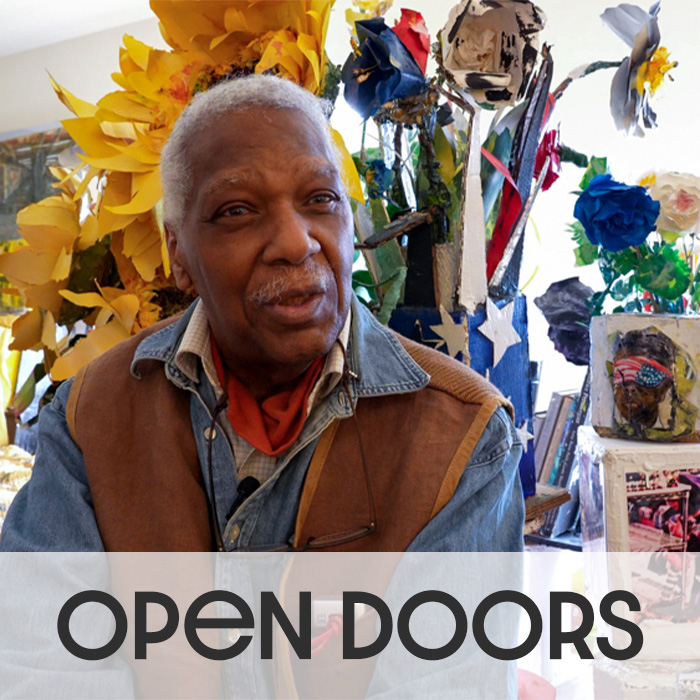
William “Bill” Saunders is an artist and Princetonian whose portfolio, spanning disciplines and decades, embodies his dedication to creativity and truth.
From his early days in Princeton — in one of the first integrated art classes in the town — to years spent creating art while incarcerated in New York, and now back in Princeton, where he transformed his studio apartment into a kind of living gallery, Bill carried his creative voice through every chapter of his life.
He describes his work as journalistic — whether through photography, painting, or sculpture — capturing realities that are often overlooked, but deeply felt.
How did you become an artist?
My mother was a domestic worker for the Goheens. Robert Goheen was the sixteenth president of Princeton University and his wife, Margaret Skelly, was throwing away boxes of art books and jazz albums. Mother brought some home and [when] I opened those books, a whole new world opened up to me.
I would mainly copy or do sketches from the works of Edgar Degas and later Rex Goreleigh, who came to Princeton around 1947.
[Rex Goreleigh started an integrated arts school called “Princeton Group Arts” one year before the Princeton Plan integrated Princeton Public Schools. Saunders was among the first students at Princeton Group Arts.]
Now, Rex and my mother, they decided that I should be part of that class. Fifteen white and fifteen Black students on Spring Street with Rex in Princeton, and we would attend regular art classes there. That was my first formal introduction to art.
When you opened those art books, what was the first artist or piece that had a real impact on you?
Joseph Malloy William Turner, the famous artist who did renditions of sun’s light. I saw one of these examples was called “The Slave Ship,” in which African slaves were thrown overboard from a ship that was about to sink, and the sea was very turbulent.
This had an effect on my emotion. But it was the way he depicted the sun’s light that impressed me. That’s sort of got me started, at least with painting, but it morphed into photography.
What was it like meeting Gordon Parks and what impact did his influence have on you?
Well, I had read a lot about Gordon, especially about his social work, the social condition, and civil rights. I was just enthralled by what he had done as a first African American along those lines.
When he expressed that he wanted to use his camera as a weapon or tool against injustice and for equal civil rights, I was just thrown overboard. I went running to Rex to tell him I wanted to go in the direction of journalism.
I told Rex and I saw tears coming down from his eyes. I didn’t understand it at the time. I thought maybe he was disappointed, you know, in me or something like that. But he just said, “Let’s go to New York.”
He didn’t tell me exactly what it was for. I thought it was to buy art supplies or something. Instead, he took me to meet Gordon.
From then on, Gordon took an interest in my direction of photography. And through Gordon, I met several peoples in the arts, in journalism. It worked out for me, I think.
How did you take inspiration from your mentors?
I decided to sort of emulate [Gordon’s social purpose] and to be a photographer displaying what it is to be impoverished. A lot of my art concentrates on poverty and the people that are dislocated: families and so forth.
It doesn’t mean that I want to be the savior, but it’s in the tradition of Gordon Parks, and Rex did the same thing with his paintings. I wanted to work in that area, and my guidance was right there.
What would you like viewers to take away from your art about poverty and separation, and these journalistic paintings?
Well, that’s a tough question. I feel, inside, compelled to take pictures and to have my art going that direction.
I think every real artist owes a commitment to society to demonstrate things that we should be conscious of in our lives, about others who are not doing so well.
I think a lot of artists do things for self-gratification, popularity or populism or trendiness, but then later they may come back around and find a need to do philanthropy through earnings or self-gratification and so on.
Well, artists like Rex and Gordon, they feel a greater need to risk their lives in that effort. So, I wish I were educated enough to explain it in more analytical terms, but this is what I do.
Do you feel that your time in prison strengthened that need to reflect the injustices? Or did you already have that part in you? And then it came out in these paintings?
I believe that most who work in this area want to do something. They want to change the system or fix the system, and they talk in terms of wrongful imprisonment and so on, which I feel that I’ve been a victim of. But there’s more to it than just that.
There is the underlying judicial system of injustice. And I believe, because of cost and expediency, that this judicial system itself is morally corrupt.
There are issues where prosecution and defense, they may make deals and, in my case, it was the prosecutor who wanted a certain outcome and was by any means necessary, even punishment and torture, going to make that outcome come about.
One of the problems that bothers me is that we have my brethren, journalists, who wish to get involved tangentially or on the surface and then pull away. They just don’t seem to want to go deep enough to see that what’s going on in the inside. For instance, I have rarely, or if ever, heard of the media speaking about these deals that are made with judges and prosecutors that are under the table that are illicit, immoral, and malicious.
And this is why I profoundly say it’s not about the artists, it’s about the art. Everybody has what they would say is a practical idea of what’s going on inside these circles of prison imprisonment and judicial misconduct. But it’s nowhere near what the truth is. And I believe the people have a right to know and art can’t be denied if there’s credibility behind it, can’t be denied of its truth.
[You can come see Bill’s art at CMAP’s SpringFest on May 6 at Suzanne Patterson Building. Click here or go to https://engage.cmaprinceton.org/component/events/event/1759 to register.]