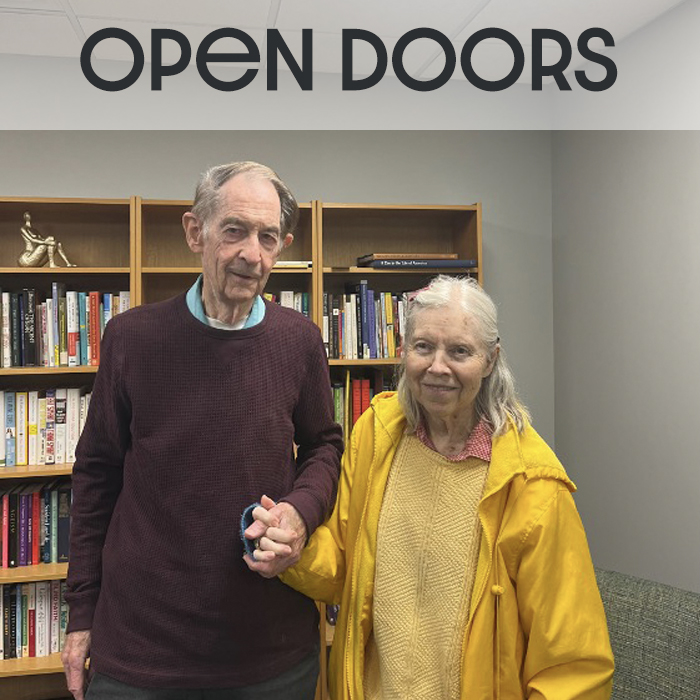
Important Update: Temporary Closure of the Nancy S. Klath Center Due to water damage, the Nancy S. Klath Center (101 Poor Farm Road) is temporarily closed for construction. For your safety, please do not visit the building. We will share updates as soon as it is ready to reopen.

CMAP remains fully operational. Staff are working remotely and from the Suzanne Patterson Building (45 Stockton Street). Programs will continue as scheduled at the Suzanne Patterson Building and in virtual formats. Thank you for your understanding.

It Was a Hoax

Recently, I was thrilled to get an email from someone I’ve known since college, more than 70 years ago. Though Jenny and I seldom got together—she lived in Toronto, while I’m in New Jersey—we talked on the phone, and every Christmas, we exchanged cards, enclosing long, newsy letters. 

Until that email came, I thought Jenny was dead. When you’re 90 or thereabouts and a distant friend dies, often the only way you find out is when there’s no card at Christmas. For the last two years, I’d had no card from Jenny.  

I had looked online for an obituary, but there wasn’t one. I’d thought about phoning Toronto, but I barely knew her husband. I imagined asking for Jenny when he picked up the phone, and how it would hurt him to have to explain that she was gone. I just couldn’t do it. There was no one else I could ask—I’d lost touch with all our mutual friends. 

Finally, I accepted the fact that Jenny had died. I missed her. When we got together, in person or by phone, we always took up just where we’d left off. She was warm, smart, funny, passionate about all kinds of things and always ready to laugh at herself. 

So when the email came, I was overjoyed: Jenny was alive! The message was quite short: 

Please write me and let me know how you are. I am chugging along and will write a message once I hear from you.

I almost fired off a long response, but it didn’t sound like Jenny. She wrote the way she talked, fast and funny. When I read her Christmas letters, I could hear her voice, and this wasn’t it. So I sent a tentative reply: 

Jenny, is that really you? I’ve sent my usual Xmas letters and got no response. I assumed the worst! How are YOU? 

The answer came a few hours later:

Yes! It’s really me! I know! It is terrible how we are losing our closest friends one by one. I can’t tell you how glad I am to receive this message from you! I will write you a message with some detail about me, but I would LOVE to hear about you!!! 

Thank God, you’re still here! Lately, I have been trying to reconnect with friends. I also am looking up people who were important in my life. I just finished reading an obit on Mike Graham. I shed a few tears when I think of what a tragedy it was that he died so young! Terrible. 

That sounded even less like Jenny. If she was too busy to send a long email, she’d have explained why in her usual, breathless fashion. And Mike was a friend of mine, but I wasn’t aware that she knew him. He died in his 30s. Why would she be reading his obit now? 

I wanted to believe the emails were from Jenny, but I had a strong hunch they came instead from someone who hoped to get details from me that they could use to rob me. These days, an awful lot of scams target older people, on the assumption that some (maybe most) of us are addled enough to believe almost anything. 

I delayed answering. After two days with no further emails from the person who might or might not be Jenny, I reluctantly concluded I really was being scammed. I bit the bullet and called her number in Toronto. If someone had hacked her email account and was using it to try to defraud her friends, her husband would want to know. But there was no answer at their home.

I’d have given almost anything to be wrong, but I was as sure as I could be that I was the intended victim of an online, phishing expedition. I was relieved that I hadn’t been sucked in, but sad all over again that I’d never see—or hear from—Jenny again.

It was a cruel hoax.


Time, Fast and Slow

When she graduated in 1996, Amy Forbus’ four years at Hendrix College felt like a miniature lifetime. College had been the biggest undertaking of her life thus far. But when she returned to the same liberal arts school in Arkansas two decades later in a staff role, periods of four years seemed to pass with alarming speed. 

“It felt like you’d blink and the first-year student who worked in our office was about to graduate,” she said. 

Forbus’ experience is a common one. As we age, time seems to move with ever-increasing speed—a phenomenon that is documented but not well understood. Human perception of time is highly subjective and flexible. But, experts say, recognizing how our perceptions change as we age can help us manage time more intentionally and perhaps even “stretch” our experience of how quickly it passes. 

In some cultures, you’re expected to apologize if you’re a minute or two late. In others, an hour or two doesn’t matter.

Most people—surveys say about 90 percent—feel time passes more quickly in later life, according to Steve Taylor, PhD, a senior lecturer in psychology at Leeds Beckett University in the UK and author of Time Expansion Experiences: The Psychology of Time Perception and the Illusion of Linear Time (2024). 

“Time seems to speed up as we get older, and it happens gradually and proportionately,” he said. 

It’s difficult to pin down the causes of this perceived speeding up of time because our time perception is so subjective. Humans’ experience of “felt time” isn’t the same as measurable “clock time,” according to Marc Wittmann, PhD, of the Institute for Frontier Areas of Psychology and Mental Health in Germany. Instead, it’s highly flexible and prone to distortions. 

“Time is inseparably tied to our experience as a whole,” Wittman wrote in his book, Felt Time: The Science of How We Experience Time (2017). Feelings, memories, happiness, language, stress, mental health, self-consciousness and other factors all affect how we experience time.  

Time seems to pass quickly when we’re absorbed in a task and more slowly when we’re bored. Hours spent “doom scrolling” on social media can seem like minutes, because platforms are intentionally designed to mesmerize users with an endless array of entertaining snippets. People who’ve survived traumatic emergencies, such as a car crash, often report experiencing that time moved very slowly during the incident. And people of all ages generally tend to estimate events as being more recent than they are.  

“I’m in England, so if I asked, ‘When did the Queen die?’ most people will say, ‘Oh, it was last year, wasn’t it?’” Taylor said. (Queen Elizabeth died in 2022.) 

Different cultures view time differently too. Author Christine Hohlbaum lives in Germany, where arriving a minute or two late for an appointment requires an apology. “But in some cultures, in Africa for example, they might say, ‘We’ll meet when the cows finish grazing,’” she said. “A couple of hours earlier or later doesn’t matter.” 

The perceived speeding up of time as we age seems to transcend cultures. One study compared surveys of people in Iraq and in the UK about how they experienced the passing of time between annual holidays. About three-quarters of respondents in the UK said Christmas seemed to come faster every year; in Iraq, a similar number said the same thing about Ramadan. 

What the Science Says

So why does time seem to move more quickly for most people as they get older? 

One popular theory about why time seems to move faster is “proportional time,” the fact that each passing year represents a smaller and smaller portion of one’s life to date. 

“As we age, time does fly, metaphorically,” said author Mary Westheimer, 70. “When you are four years old, a year is one-fourth of your life. When you are 40 years old, it’s just one-fortieth of your life.” 

Another explanation: as we get older, we no longer experience life with “young” eyes. Psychologist William James (1842-1910) first proposed this. As children, he wrote, “We have an absolutely new experience, subjective or objective, every hour of the day.” 

As we age, James observed, time seems to speed up because “each passing year converts some of this experience into an automatic routine, which we hardly note at all.”

It’s akin to the experience of a daily commute—so familiar that the driver can navigate on “autopilot,” and arrive at the destination with no memory of the drive or sense of the passage of time. As we age, we grow progressively desensitized to our surroundings and absorb gradually less information. 

However, the subjectivity of time is not unique to older adults. A teenager experiences time as passing faster than a child; a retired older adult feels like the years fly by even faster than in midlife. Experiments have demonstrated how time perception changes with age, even in controlled situations

For example, research subjects were asked to listen to music or watch a film, then to estimate how much time had passed. Younger people tended to estimate that more time had passed than older people.  

Days can seem long for older people who are bored or lonely, though they feel that years are speeding by.

Many people remember how slowly time seemed to pass in childhood, whether it was waiting for Christmas morning or the first day of summer. Author David Hamilton recalled family trips to the seaside when he was child, which seemed to take many hours. Recently, he was shocked to discover that the drive took only about 45 minutes.  

While there does seem to be a biological component of time perception, humans are not equipped with precise internal clocks in the same way computers are, Taylor said. Without timepieces or external cues, such as sunrise and sunset, our perception of time can be surprisingly unreliable. 

In one famous 1962 experiment, geologist Michel Siffre spent 63 days inside a cave to see how his sense of time was affected without the normal day-night flow of life. Siffre reported that his felt time had “telescoped.” His daily cycle of wakefulness and sleep stretched from 24 to about 25 hours. And he was shocked by how quickly the research time went by for him at the end of the 63 days. What had felt like one month while in the cave was in fact two on the surface.

Sometimes the perception of the speed or slowness of time is paradoxical. Older people who are retired, bored or lonely may experience the days as long, even as the years seem to fly by. That’s because people experience time differently retrospectively (looking back in time) versus prospectively (while going through it). In one 2019 study, many participants (75 and older) reported that time had slowed down, especially among those who were unhappy. 

“The best predictors of this slowing down of time were the negative affects, namely sadness, which were particularly high among the participants living in a retirement home,” researchers noted. 

Conversely, there’s the “vacation paradox,” in which time seems to fly on a holiday, because it’s so enjoyable, but in retrospect, the experience feels longer than it was because of the abundance of memories.

Age-related cognitive decline also can impair older adults’ ability to perceive time. Older people, for example, may find it more difficult to recall how long ago something went into the oven. 

More seriously, there’s dementia-related dyschronometria, the inability to accurately estimate the amount of time that has passed. People with dementia may confuse minutes with hours or misjudge the difference between days, or even seasons. Similarly, those with Alzheimer’s may exhibit time-shifting—lapsing into the illusion of being in another time and place. They may dress inappropriately for the weather, thinking it’s a different season, or become distressed because a loved one hasn’t “visited in years,” even though the person visited the day before. 

Stretching Time

Psychiatrist Carole Lieberman, MD, says older patients bring up concerns that time is passing too quickly, which heightens their awareness of mortality. 

“As we age, we are more aware of how little there is left,” she said. “We start taking this into consideration when choosing what we do. For example, we ask ourselves if there’s enough time left to start a project that takes a long time, such as a home remodel or studying for another career.”

There are ways to “stretch” our experience of time, Taylor said. Mindfulness practices like meditation boost conscious awareness and help “de-automatize” perceptions of daily life. 

Simply resisting the tendency to fall into routines can also stretch time.

“Humans are very routine oriented, because our routines allow us to reduce uncertainty,” said Beth Ribarsky, PhD, professor of interpersonal communications and media at the University of Illinois, Springfield. “We like knowing what to expect. But we can increase novelty in our lives with something as simple as taking a different route to work or going out to a different restaurant or trying new activities.”   

Embracing the limits of one’s time can also motivate and inspire older adults, Lieberman added. 

 “We can either try to do more in a day, get on with things we always hoped to accomplish, or we can let ourselves be depressed and figure, ‘What’s the use?’” she said. “This awareness can make later years better or worse.” 

Lifestyle Changes 

Of course, time is perceived in more ways than just speed or slowness. As people age, schedules and lifestyles change. That, in turn, changes the way their time is allocated and how the passage of time is perceived. Daily chores that were once dispatched quickly—meal preparation, grocery shopping, a daily shower—may take longer. Older adults, even healthy ones, have more doctors’ appointments, which take up a more significant portion of time. Days filled with travel or multiple activities can feel exhausting and may require a day or two of rest to recover. 

Kevin Hall, 68, noticed how his relationship with time changed when he retired six years ago. 

“After 40 years in corporate America, time flies by much faster now than it did while I was working,” he said. “I’m doing more fun things and just forget to even think about time.” 

Meetings, deadlines and kids’ activities dictated his schedule during his work years. Now, Hall spends his time writing books and enjoying the outdoors. Like many older adults, he eats dinner a bit earlier and goes to bed a bit earlier, partly because he has the freedom to do so, and partly because that seems to better suit his body clock.

“Now I am the boss of my time,” he said. “I decide when to eat, go to bed or go to certain activities, or not.” 

Hohlbaum adds that her life was ruled by “clock combat” back in 2009 when she wrote her book, The Power of Slow: 101 Ways to Save Time in Our 24/7 World. Between caring for young children and meeting constant deadlines and appointments, she was always in a hurry. Now, at age 56, Hohlbaum is less driven by the clock. 

“When I look back at the person who wrote this book, God bless her, she was trying to manage everything,” she said. “Now I just want to enjoy my life. There’s nothing to prove. Now time feels more abundant.” 

Cameras Are Popping Up in Long Term Care Facilities

Columnist Paula Span explains this growing phenomenon: why and how it’s being done and what the pros and cons are. KFF Health News posted her reporting on April 21, 2025. Her column also ran on the New York Times. Funding from the Silver Century Foundation helps KFF Health News develop articles (like this one) on longevity and related health and social issues. 

The assisted living facility in Edina, MN, where Jean Peters and her siblings moved their mother in 2011, looked lovely. 

“But then you start uncovering things,” Peters said.

Her mother, Jackie Hourigan, widowed and developing memory problems at 82, too often was still in bed when her children came to see her midmorning.

“She wasn’t being toileted, so her pants would be soaked,” said Peters, 69, a retired nurse practitioner in Bloomington, MN. “They didn’t give her water. They didn’t get her up for meals.” Her mother dwindled to 94 pounds.

Most ominously, Peters said, “we noticed bruises on her arm that we couldn’t account for.” Complaints to administrators—in person, by phone and by email—brought “tons of excuses.”

So Peters bought an inexpensive camera at Best Buy. She and her sisters installed it atop the refrigerator in her mother’s apartment, worrying that the facility might evict her if the staff noticed it.

Monitoring from an app on their phones, the family saw Hourigan going hours without being changed. They saw and heard an aide loudly berating her and handling her roughly as she helped her dress.

They watched as another aide awakened her for breakfast and left the room even though Hourigan was unable to open the heavy apartment door and go to the dining room. “It was traumatic to learn that we were right,” Peters said.

After filing a police report and a lawsuit, and after her mother’s 2014 death, Peters in 2016 helped found Elder Voice Advocates, which lobbied for a state law permitting cameras in residents’ rooms in nursing homes and assisted living facilities. Minnesota passed it in 2019.

Though they remain a contentious subject, cameras in care facilities are gaining ground. By 2020, eight states had joined Minnesota in enacting laws allowing them, according to the National Consumer Voice for Quality Long-Term Care: Illinois, Kansas, Louisiana, Missouri, New Mexico, Oklahoma, Texas and Washington.

Laws in some states require facilities to allow cameras, but it’s not clear that facilities take those laws seriously.

The legislative pace has picked up since, with nine more states enacting laws: Connecticut, North Dakota, South Dakota, Nevada, Ohio, Rhode Island, Utah, Virginia and Wyoming. Legislation is pending in several others.

California and Maryland have adopted guidelines, not laws. The state governments in New Jersey and Wisconsin will lend cameras to families concerned about loved ones’ safety.

But bills have also gone down to defeat, most recently in Arizona. For the second year, a camera bill passed the House of Representatives overwhelmingly but, in March, failed to get a floor vote in the state Senate.

“My temperature is a little high right now,” said State Rep. Quang Nguyen, a Republican who is the bill’s primary sponsor and plans to reintroduce it. He blamed opposition from industry groups, which in Arizona included LeadingAge, which represents nonprofit aging services providers, for the bill’s failure to pass.

The American Health Care Association, whose members are mostly for-profit long term care providers, doesn’t take a national position on cameras. But its local affiliate also opposed the bill.

“These people voting no should be called out in public and told, ‘You don’t care about the elderly population,’” Nguyen said.

A few camera laws cover only nursing homes, but the majority include assisted living facilities. Most mandate that the resident (and roommates, if any) provide written consent. Some call for signs alerting staffers and visitors that their interactions may be recorded.

The laws often prohibit tampering with cameras, or retaliating against residents who use them, and include “some talk about who has access to the footage and whether it can be used in litigation,” added Lori Smetanka, JD, executive director of the National Consumer Voice for Quality Long-Term Care.

It’s unclear how seriously facilities take these laws. Several relatives interviewed for this article reported that administrators told them cameras weren’t permitted, then never mentioned the issue again. Cameras placed in the room remained.

Some families use a camera just to stay in touch. 

Why the legislative surge? During the COVID-19 pandemic, families were locked out of facilities for months, Smetanka pointed out. “People want eyes on their loved ones.”

Changes in technology probably also contributed, as Americans became more familiar and comfortable with video chatting and virtual assistants. Cameras have become nearly ubiquitous—in public spaces, in workplaces, in police cars and on officers’ uniforms, in people’s pockets.

Initially, the push for cameras reflected fears about loved ones’ safety. Kari Shaw’s family, for instance, had already been victimized by a trusted home-care nurse who stole her mother’s prescribed pain medications.

So when Shaw, who lives in San Diego, and her sisters moved their mother into assisted living in Maple Grove, MN, they immediately installed a motion-activated camera in her apartment.

Their mother, 91, has severe physical disabilities and uses a wheelchair. “Why wait for something to happen?” Shaw said.

In particular, “people with dementia are at high risk,” added Eilon Caspi, PhD, a gerontologist and researcher of elder mistreatment. “And they may not be capable of reporting incidents or recalling details.”

More recently, however, families are using cameras simply to stay in touch.

Anne Swardson, who lives in Virginia and in France, uses an Echo Show, an Alexa-enabled device by Amazon, for video visits with her mother, 96, in memory care in Fort Collins, CO. “She’s incapable of touching any buttons, but this screen just comes on,” Swardson said.

Art Siegel and his brothers were struggling to talk to their mother, who, at 101, is in assisted living in Florida; her portable phone frequently died because she forgot to charge it. “It was worrying,” said Siegel, who lives in San Francisco and had to call the facility and ask the staff to check on her.

Now, with an old-fashioned phone installed next to her favorite chair and a camera trained on the chair, they know when she’s available to talk.

Both camera opponents and their supporters have expressed concern about residents’ privacy. 

As the debate over cameras continues, a central question remains unanswered: Do they bolster the quality of care? “There’s zero research cited to back up these bills,” said Clara Berridge, PhD, a gerontologist at the University of Washington who studies technology in elder care. “Do cameras actually deter abuse and neglect? Does it cause a facility to change its policies or improve?”

Both camera opponents and supporters cite concerns about residents’ privacy and dignity in a setting where they are being helped to wash, dress and use the bathroom.

“Consider too the importance of ensuring privacy during visits related to spiritual, legal, financial or other personal issues,” Lisa Sanders, a spokesperson for LeadingAge, said in a statement.

Though cameras can be turned off, it’s probably impractical to expect residents or a stretched-thin staff to do so.

Moreover, surveillance can treat those staff members as “suspects who have to be deterred from bad behavior,” Berridge said. She has seen facilities installing cameras in all residents’ rooms: “Everyone is living under surveillance. Is that what we want for our elders and our future selves?”

Ultimately, experts said, even when cameras detect problems, they can’t substitute for improved care that would prevent them—an effort that will require engagement from families, better staffing, training and monitoring by facilities and more active federal and state oversight.

“I think of cameras as a symptom, not a solution,” Berridge said. “It’s a band-aid that can distract from the harder problem of how we provide quality long-term care.”

Meet Val and Martha

Val and Martha – A Life of Adventure, Family, and Connection

We had the pleasure of speaking with Val Mathews and Martha, who both participate in the Nutrition Program at the Suzanne Patterson Building. Their lives have been full of adventure, family, and meaningful connections. Here is their story:


Q: Can you tell us a bit about yourself, your background, and what brought you to Princeton?

Val:
I grew up in Virginia. I had a deep interest in physics and worked in the military-industrial complex for a while. After that, I took some time to explore the world. I lived in southern Russia and the Texas oil fields, and those experiences really shaped who I am. But eventually, I found my number one woman: Martha. That was the moment I realized that life isn’t just about places and jobs; it’s about the people you connect with along the way.

Martha:
I was born in Washington, D.C. and have an identical twin sister. Growing up, tennis was a huge part of my life, and it was something my twin sister and I shared. However, after I fell and broke my hip, I had to leave the sport behind. Even though I couldn’t play anymore, I found joy in watching others, like John Isner, and admiring their talents. It’s funny how life changes, and tennis still remains something that binds my sister and me, even though I no longer play.


Q: How did you find your way to Princeton? What has been meaningful to you about living here?

Martha:
When it came time to choose schools for our children, we wanted the best for them. We found that West Windsor High School was the right place for them, and it was only a few blocks from our home, which made it all the more convenient. We were looking for a community that values education and personal growth, and Princeton has always embodied those values.

Val:
Princeton has been an ideal place for our family. Martha has always been passionate about teaching. She was a wonderful elementary school teacher and later worked as a director at Princeton University’s nursery school. For me, living in Princeton has been about finding balance — having a supportive community and raising our family in a place where education, culture, and the arts thrive.


Q: What has been the most fulfilling part of your life so far?

Val:
The most fulfilling part of my life has been the chance to travel and connect with people from different parts of the world. The cultural exchanges we’ve had in our home, from hosting guests from Russia, Bulgaria, Kazakhstan, and East Germany — have broadened my view of the world. One of the most enriching experiences was when we hosted a student from Finland. She came to West Windsor High School as a senior to improve her English, and watching her grow and adapt to life in the U.S. was an incredible experience. It taught me how interconnected we all are, no matter where we come from.

Martha:
I couldn’t agree more. The exchanges we’ve had have really shaped our understanding of the world. It’s opened up our minds to different perspectives, and I’ve learned so much from these cultural interactions. It also gave our family the chance to appreciate the richness of other cultures and ways of life.


Q: What has been your experience with the Center for Modern Aging Princeton?

Val:
After Martha had her surgeries and was in and out of rehab, I found myself spending a lot of time alone. I qualified for the Nutrition Program here and began attending regularly. Honestly, it’s been a lifeline. It’s not just the food, although the meals are wonderful, it’s the people. Coming here has given me a sense of connection I was missing, and it’s been great for both my physical and emotional well-being. The social aspect has been just as important as the nutrition.

Martha:
I couldn’t agree more. After my surgeries, I’ve really come to appreciate the space CMAP offers. It’s a place where I feel seen and heard, and I’m not just another face in the crowd. Everyone here makes you feel welcome, and the camaraderie is really special. It’s more than just a place for food, it’s a place for connection and support. I truly feel at home here.


Q: What do you think is the most important lesson you’ve learned in your life?

Val:
For me, the most important lesson has been the value of staying curious and never stopping the learning process. No matter how old you get, there is always something new to discover, whether it’s a place, a person, or an idea. I think we’re all constantly evolving, and that’s what makes life exciting. It’s important to keep an open mind and heart.

Martha:
For me, it’s all about savoring the little moments and not taking life too seriously. When you stop and appreciate the simple joys — whether it’s a good meal with family, a quiet walk, or a shared laugh, you find true happiness. It’s those little things that matter most in life.


Q: What do you most enjoy doing with your grandchildren?

Val:
Spending time with our grandchildren is pure joy. One of our granddaughters, when she was just six years old, challenged me to an arm-wrestling match. She said, “Grandpa, I’m your woman.” It was a moment I’ll never forget. The confidence they bring to everything they do is so inspiring, and it reminds me to keep that childlike enthusiasm in my own life.

Martha:
We love to take them out to eat and spend time with them, but they’re so busy with school now that we don’t get to see them as often as we’d like. But whenever we can, it’s a real treat. We just enjoy being together and soaking up their energy.


Q: How do you feel about the future? What are your hopes for the next chapter in your life?

Val:
We’re just so grateful for everything we’ve experienced in life. Watching our children and grandchildren grow and succeed has been a joy, and we just want to continue being a positive influence on them. Our focus now is on enjoying each day and making sure we’re living fully.

Martha:
I agree. We’ve had a rich and fulfilling life, and now it’s about appreciating each day. We want to continue being involved in our family’s lives and continue making memories together. Life’s short, so we’re just going to enjoy it while we can.

_____________________________________

Val and Martha’s story is a testament to the power of connection, love, and adventure. Their journey, full of cultural exchanges, family, and community involvement, shows us that the key to a fulfilling life lies in staying curious, connected, and grateful. Through their participation in the Nutrition Program at CMAP, they’ve found not only nourishment for their bodies but also a deeper sense of belonging. Their story reminds us that no matter our age, we are always capable of learning, growing, and sharing our wisdom with others.

BE THE FUEL

MAKE A DONATION TODAY

Your generosity is truly the fuel that empowers CMAP to change lives and to help older adults discover their “why!”

We invite you to donate to the 2023–2024 Annual Giving Campaign by June 30 to help us reach our goal.